

wilt
 6
7.4
6
7.4

- noun
- /wɪlt/
- Specialized
- Some of these cause symptoms similar to leaf spot of sesame, such as spot, blight, and wilt (Bender, 1999).
- fusarium wilt
- wilt disease
Loading YouTube…
Watch on YouTubeAnd so I had discovered that I had transmitted reticulum wilt.
- And so I had discovered that I had transmitted reticulum wilt.
- So this could be bacterial wilt, this could be Fusarium wilt, this could be things like damping off.
Examples
-
A collection trip to Bolivia yielded strains of peanuts that may be resistant to tomato spotted wilt virus, a disease that reduces peanut size and yield.
Academic text (2003) -
During the summer, many flowers may show signs of wilt as the heat takes a toll on their health.
-
"Most are also resistant to an early death from diseases like Verticillium wilt."
Academic text (2003) -
We also use the information to pinpoint outbreaks of plant diseases such as Fusarium wilt and vine decline.
Academic text (1996) -
High incident sunlight will result in leaf wilt (midday wilt) even for plants whose roots are in water-saturated soil (Young and Smith 1980).
Academic text (1997) -
Farmers are particularly concerned about wilt affecting their crops, as it can lead to significant losses.
-
The gardener noticed that several plants in her greenhouse were suffering from wilt and treated them immediately.
Synonyms

A plant disease that makes leaves and stems droop and dry up
Compounds

- Specialized

 1
7.4
1
7.4
A plant disease that makes leaves wilt and turn yellow, caused by a fungus called Fusarium

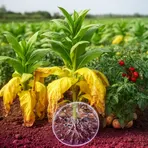
- Specialized
A disease caused by bacteria that makes tobacco, tomato, and potato leaves wilt and turn yellow
How Damaging

Surface Forms
Etymology
Wilt comes from an old English word meaning 'to dry up' and is related to the common word wither, so as a noun wilt names the condition when a plant droops and shrivels because it is attacked or has no water.