
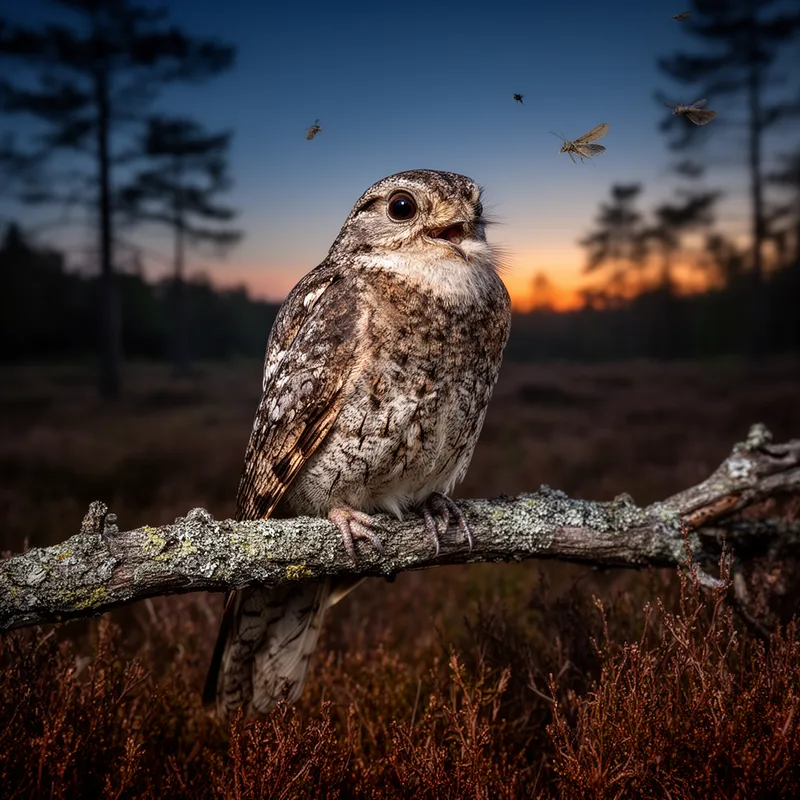
European nightjar
- noun
- UK
- The European nightjar is most active at dusk and dawn, hunting insects on the wing.
Examples
-
We heard the distinctive churring call of a European nightjar in the heathland.
-
Conservationists are working to protect the habitat of the European nightjar due to declining populations.
-
The European nightjar is known for its beautiful song.
-
Look! A European nightjar is singing!
-
The European nightjar is most active at dusk and dawn, hunting insects on the wing.
-
We heard the distinctive churring call of a European nightjar in the heathland.
-
Conservationists are working to protect the habitat of the European nightjar due to declining populations.
Synonyms


 1
9.5
1
9.5
A bird active at night with grey-brown feathers and large eyes that eats insects

A bird in Europe that comes out at night to eat insects
A night bird of Europe and western Asia with speckled feathers and a low continuous call
Surface Forms
Morphology
The phrase literally combines the adjective 'European' (from Europe) with the noun 'nightjar' (a nocturnal bird), so its meaning — a nightjar species found in Europe — is directly and transparently derived from the parts. This follows a common adjective + noun species-naming pattern that is cross-linguistically familiar, so a B1 learner who knows both words can infer the meaning.
Etymology
European nightjar: The name European nightjar comes from the bird being active at night and from the old word jar, which describes its rough, jarring call. So the name points to a 'night' bird known for a strange, rattling call.