

European goatsucker
- noun
- UK
- The European goatsucker is more often heard than seen due to its nocturnal habits.
Examples
-
During summer evenings, the churring sound of the European goatsucker can be heard in the countryside.
-
Researchers set up cameras to observe the feeding behavior of the European goatsucker at dusk.
-
The European goatsucker is known for its unique call.
-
Have you ever seen a European goatsucker in the wild?
-
During summer evenings, the churring sound of the European goatsucker can be heard in the countryside.
-
The European goatsucker is more often heard than seen due to its nocturnal habits.
-
Researchers set up cameras to observe the feeding behavior of the European goatsucker at dusk.
Synonyms


 1
9.5
1
9.5
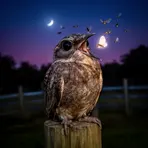
A bird active at night with grey-brown feathers and large eyes that eats insects
 1
9.9
1
9.9
A bird active at night with large eyes and brown and grey feathers that eats insects

A bird in Europe that comes out at night to eat insects

A night bird in Europe that is active at dusk and dawn with camouflaged feathers and a churring call
Surface Forms
Morphology
The phrase is a simple adjectival modification: 'European' specifies the region and 'goatsucker' names the bird species, so a learner who knows both constituents can infer it means the goatsucker found in Europe. This adjective+noun composition is a standard, cross-linguistic pattern and therefore immediately comprehensible to a B1 learner who knows the two words.
Etymology
European goatsucker: The name comes from old folk stories that people thought the bird would suck milk from goats at night. In fact the European goatsucker is an active-at-night bird called a 'nightjar' with mottled feathers and a low buzzing call, and that strange story is why it got the name.