

Elymus arenarius
- noun
- Specialized
- The roots of Elymus arenarius are effective at preventing erosion along sea coasts.
Examples
-
Many coastal restoration projects use Elymus arenarius for dune reinforcement.
-
Many coastal regions plant Elymus arenarius to prevent erosion.
-
Elymus arenarius is commonly planted on beaches to help stabilize shifting sands.
-
The Elymus arenarius is crucial for dune stabilization.
-
Elymus arenarius is commonly planted on beaches to help stabilize shifting sands.
-
Many coastal restoration projects use Elymus arenarius for dune reinforcement.
-
The roots of Elymus arenarius are effective at preventing erosion along sea coasts.
Synonyms

A coarse grass that grows on sandy shores and keeps sand in place

A dune grass that grows on Pacific beaches to hold sand and stop erosion

A tough grass that grows on sand near the sea to hold the dunes in place
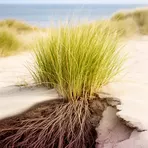
A grass from Europe that grows on sand and holds dunes together
Surface Forms
Morphology
Elymus + arenarius
This is a Latin binomial combining the genus name Elymus (a group of grasses) with the epithet arenarius, which etymologically means 'of the sand' — so if a learner knows both constituents they can directly infer a sand-dwelling grass used for dune stabilization. Although arenarius is a Latin term not found in common English dictionaries (and thus unlikely to be known by a typical B1 learner), the meaning is compositional and predictable from the parts when those parts are understood.
Etymology
Elymus arenarius comes from old words: Elymus means a kind of grass and arenarius means 'sand'. So the name shows it is a grass for sandy beaches and explains why people plant it to keep sand in place.

