

sea lyme grass
- noun
- US
- The sea lyme grass plays a crucial role in preventing coastal erosion by stabilizing the dunes.
Examples
-
You can recognize sea lyme grass by its tough, bluish-green leaves and tall stems.
-
Botanists planted sea lyme grass to help restore the damaged shoreline habitat.
-
The sea lyme grass grows well in sandy soil.
-
Many coastal areas rely on sea lyme grass for dune stabilization.
-
To combat erosion effectively, environmentalists planted sea lyme grass along the coast.
-
The local community organized a campaign to grow sea lyme grass for sand dune stabilization.
-
During the restoration project, workers introduced sea lyme grass to help secure the shifting sands.
Synonyms


 1
3.7
1
3.7
A tough grass with strong roots that grows on sandy shores and stops sand dunes from moving

A dune grass that grows on Pacific beaches to hold sand and stop erosion
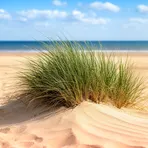
A coarse grass that grows on sandy shores and keeps sand in place

A grass that grows on sandy coasts and helps keep sand from being carried away by wind or water
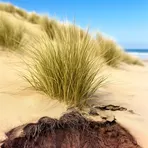
A coarse grass that grows on sand dunes and holds sand in place
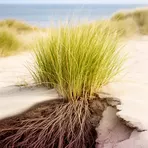
A grass from Europe that grows on sand and holds dunes together
Surface Forms
Morphology
The phrase combines 'sea' (location) + 'lyme' (a specific varietal/name) + 'grass' (a plant), so a learner who knows the constituents would likely infer it denotes a type of grass associated with the sea. However, 'lyme' is an uncommon, species-level lexical item and the precise ecological sense (dune-stabilizing, Pacific-coast species) is lexicalized and not fully predictable from the parts alone.
Etymology
The name sea lyme grass is a simple picture: sea because it grows by the ocean, and lyme grass because its strong roots hold the sand. Think of the roots 'tying' the dunes so they do not move, which is why the name is used for a grass that helps 'stabilize sand dunes'.