

Eastern Sioux
- noun
- Many Eastern Sioux still practice traditional ceremonies.
Examples
-
Many Eastern Sioux were relocated during the 19th century due to westward expansion.
-
The Eastern Sioux have a distinct dialect within the Sioux language group.
-
He studied the traditions of the Eastern Sioux for his anthropology research.
-
The Eastern Sioux have a rich cultural heritage.
-
He studied the traditions of the Eastern Sioux for his anthropology research.
-
Many Eastern Sioux were relocated during the 19th century due to westward expansion.
-
The Eastern Sioux have a distinct dialect within the Sioux language group.
Synonyms

A person who belongs to the eastern branch of the Sioux people

A person from the eastern branch of the Sioux people in the central United States
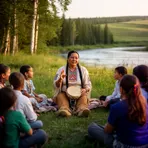
A member of the Sioux people who live in the upper Midwest of the United States
Surface Forms
Morphology
The phrase simply combines the adjective 'eastern' (relating to the east) with the noun 'Sioux' (the people), so its meaning — members of the Sioux from the eastern branch — is directly derivable from the constituents. This ADJ+NOUN compositional pattern is common cross-linguistically and would be clear to a B1 learner who knows both words.
Etymology
The name Eastern Sioux was used for Sioux groups who lived to the east of other Sioux groups. The word Sioux was a name used by other tribes and by French settlers, and Eastern just points to their location, so Eastern Sioux simply means 'Sioux people of the east'.

