

Santee Sioux
- noun
- /ˈsænti suː/
- Many Santee Sioux tribespeople are actively involved in preserving their language and traditions for future generations.
- Santee Sioux Charles
Examples
-
During the annual gathering, members of the Santee Sioux shared their history and customs with visitors.
-
For example, South Dakota officials expressed hostility to the Flandreau Santee Sioux Tribe's marijuana resort plans based in part on fears that state residents would ingest marijuana on the reservation and then return to state territory, where marijuana was illegal.
Academic text (2017) -
30 Santee Sioux narrator Charles E. Eastman similarly memorialized an early white missionary.
Academic text (1999) -
Amid national controversy over marijuana legalization, the Flandreau Santee Sioux Tribe attempted to open a marijuana
Academic text (2017) -
Santee Sioux Charles Eastman vividly conveyed the positive and negative significance of the peer group: that is, other pupils.
Academic text (1999) -
Despite what initially appeared to be the tacit approval of the federal government, the Flandreau Santee Sioux Tribe was forced to abandon its plans for a marijuana resort amid hostility from South Dakota.
Academic text (2017) -
The Santee Sioux people have a rich cultural heritage that includes traditional storytelling and music.
Synonyms

A person who belongs to the eastern branch of the Sioux people
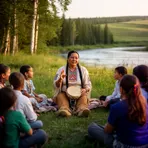
A member of the Sioux people who live in the upper Midwest of the United States

A Native American person from the eastern group of the Sioux people
Surface Forms
Morphology
This is a straightforward proper-noun compound: the meaning is directly compositional from 'Santee' (the Eastern Sioux subgroup) + 'Sioux' (the larger Native American people), so a learner who knows both constituents will infer it denotes members of that subgroup. The formation matches common cross-linguistic patterns for naming subgroups (e.g. 'Northern Irish', 'French Canadian'), making it transparent to B1 learners.
Etymology
The name Santee Sioux may come from a Dakota word meaning 'knife', with Santee used for one group of the Sioux who lived in the east in what is now Minnesota. So the name today refers to that specific group of people.

