

Santee Dakota
- noun
- /ˈsænti dəˈkoʊtə/
- The Santee Dakota have a rich tradition of storytelling and ceremonies.
Examples
-
Many Santee Dakota were relocated to reservations in the mid-19th century.
-
She is studying the language of the Santee Dakota as part of her research on indigenous cultures.
-
The Santee Dakota have a rich cultural heritage.
-
Many Santee Dakotas still practice traditional ceremonies.
-
Many Santee Dakota were relocated to reservations in the mid-19th century.
-
She is studying the language of the Santee Dakota as part of her research on indigenous cultures.
-
The Santee Dakota have a rich tradition of storytelling and ceremonies.
Synonyms
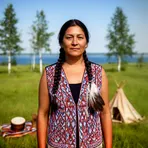
A person who belongs to the eastern branch of the Sioux people

A person from the eastern branch of the Sioux people in the central United States

A Native American person from the eastern group of the Sioux people

A person who belongs to a Native American people from the northern plains, often called the Sioux

A Native American people from the plains of North America with shared language and culture
Surface Forms
Morphology
The name 'Santee Dakota' is compositionally built from 'Santee' (the Santee subgroup) + 'Dakota' (the Dakota people), so its meaning as a member of the Santee branch of the Dakota is directly derivable from the constituents. Although it is a proper name that presupposes some cultural knowledge, a B1 learner who knows both constituent meanings can infer the MWE's referent, so it is transparent.
Etymology
Santee Dakota may come from the Dakota word Isanti, which is often said to mean 'knife people'. That name was used for the eastern branch of the Dakota who lived in the upper Midwest, so today Santee Dakota refers to that group of people.

