
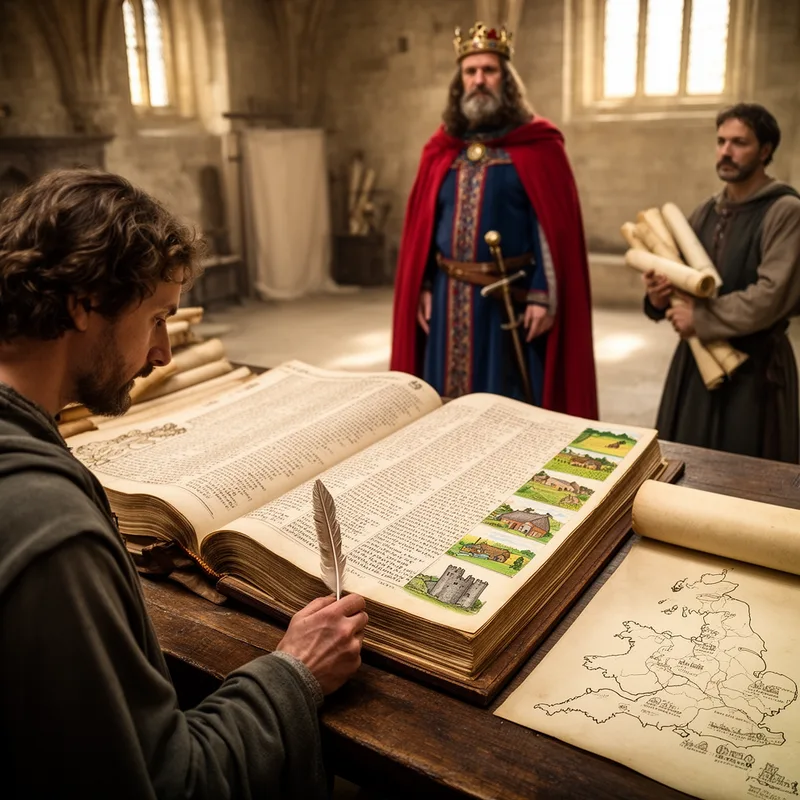
Domesday Book
- proper noun
- /ˈdoʊmzdeɪ bʊk/
- William the Conqueror ordered the creation of the Domesday Book to assess the resources of his new kingdom.
Examples
-
Even got a mention in the Domesday Book.
-
The Domesday Book in 1085 recorded about 40.
Blog text (14) -
Wine was widely grown in England during the MWP; have a look in the Domesday Book.
Blog text (14) -
The Domesday Book, a great survey of English wealth in 1086, listed it as one of the 10 largest towns in England, with three churches and yearly royal taxes of 68,000 herring.
Academic text (2009) -
The Domesday Book, compiled in 1086, provides a detailed record of land ownership in England.
-
Many historians consider the Domesday Book an essential source for understanding medieval England's economy.
Synonyms
 1
9.9
1
9.9

A book from 1086 listing land and property in England
Official record from 1086 listing landowners and resources in England
Surface Forms
Morphology
This is a lexicalized proper name for a specific historical record; knowing 'book' does not allow a learner to infer the specialised sense 'official 1086 land and property survey' from the constituent 'Domesday', which is itself an opaque historical name. The meaning is culturally and historically specific rather than compositional, so it is not predictable for a B1 learner who only knows the parts.
Etymology
The Domesday Book was a huge list made in 1086 that named who owned land and how much it was worth. The name Domesday comes from the word 'Doomsday', meaning the last judgment, because people thought the book's lists were 'final'. That's why it is still the official record of land in England.