
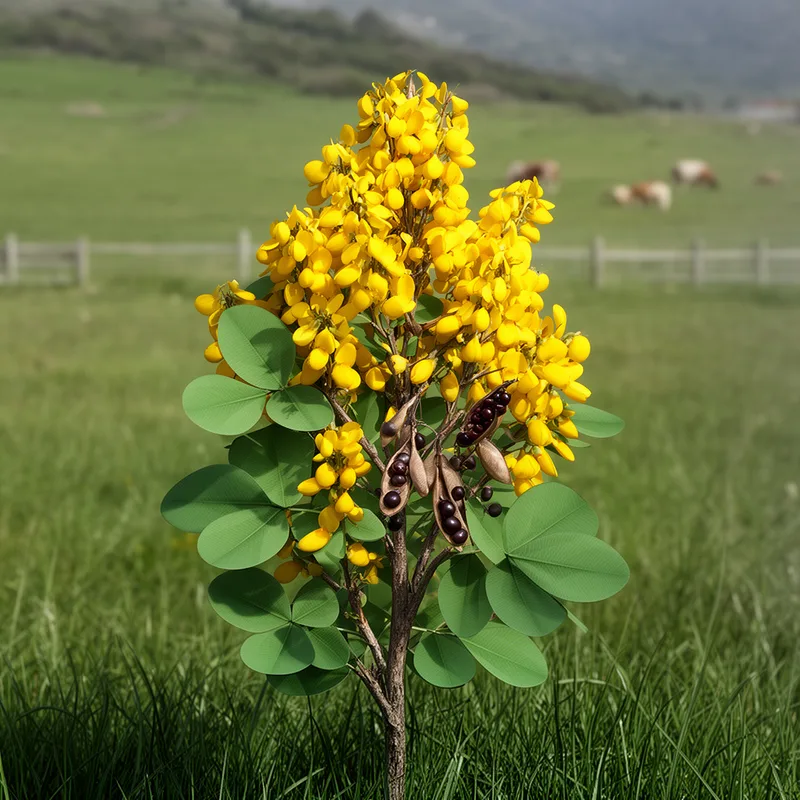
Cytisus ramentaceus
- noun
- Specialized
- Farmers in the region avoid grazing livestock where Cytisus ramentaceus grows because its seeds are poisonous.
Examples
-
Cytisus ramentaceus is noted for its dense clusters of bright yellow flowers in the spring.
-
Botanists sometimes debate whether Cytisus ramentaceus should be placed in a different genus.
-
The Cytisus ramentaceus is known for its beautiful yellow flowers.
-
Have you ever seen a Cytisus ramentaceus in bloom?
-
Cytisus ramentaceus is recognized for its erect form and clusters of yellow flowers that bloom in the spring.
-
Farmers know that Cytisus ramentaceus produces poisonous seeds, so they prevent livestock from grazing near it.
-
During the spring, the bright yellow flowers of Cytisus ramentaceus attract many pollinators in the garden.
Synonyms

An upright bush with three-part leaves, dense yellow flowers, and poisonous seeds
A shrub with bright yellow flowers and poisonous seeds
Surface Forms
Morphology
Cytisus + ramentaceus
This is a scientific Latin binomial (a species name) rather than a normal compositional phrase; even knowing 'Cytisus' (a broom shrub) and the Latin-looking epithet does not allow a B1 learner to infer the specific species traits or the full meaning given in the definition. Botanical names function as labels and require domain knowledge or dictionary lookup, so the meaning is not predictably derivable from the constituents for general learners.
Etymology
Cytisus ramentaceus may come from old plant words: Cytisus was a name for a small 'shrub' and ramentaceus may come from a word meaning 'covered with small flakes or scales', a picture you can imagine as tiny flaky bits on the stems or leaves. So the name helps you remember it is a yellow-flowering shrub with a rough, flaked look and 'poisonous seeds'.

