

Petteria ramentacea
- noun
- Specialized
- The erect shrub Petteria ramentacea displays striking clusters of yellow flowers during spring.
Examples
-
Researchers studied the toxicity of the seeds produced by Petteria ramentacea.
-
The botanical garden features a rare specimen of Petteria ramentacea in its Balkan section.
-
Petteria ramentacea is often admired for its vibrant yellow flower clusters in early summer.
-
The Petteria ramentacea grows well in sunny areas.
-
I saw a Petteria ramentacea blooming in the garden.
-
Petteria ramentacea is known for its potent seeds that can be harmful if ingested.
-
In southeastern Europe, Petteria ramentacea thrives in well-drained soil and sunny locations.
Synonyms

A small upright bush from southeastern Europe with large three-part leaves, dense yellow flowers and poisonous seeds
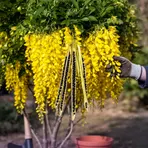
A shrub with bright yellow flowers and poisonous seeds
Surface Forms
Morphology
Petteria + ramentacea
This is a scientific Latin binomial (genus + specific epithet); knowing that 'Petteria' is a taxonomic genus label does not convey the descriptive meaning of the plant, and 'ramentacea' is not an English word (not found in the dictionary) so its semantics are not accessible to a B1 learner. Binomial names are conventional labels rather than compositional English phrases, so the overall meaning (an erect shrub with specific botanical features) cannot be derived from the parts.
Etymology
The plant name Petteria ramentacea may be 'named for' a person called Petter, while ramentacea comes from Latin meaning 'covered with small flakes or scales'. So the name gives an easy picture: a shrub linked to a person and showing small scaly parts with clusters of yellow flowers.

