

Constantinople (Sixth Ecumenical Council)
- noun
- Specialized
- The council of Constantinople in 680–681 condemned Monothelitism and clarified Christological doctrine.
Examples
-
The council of Constantinople held in 680–681 defined that Christ has both divine and human wills.
-
The decisions of Constantinople (Sixth Ecumenical Council) had a lasting impact on Christian doctrine.
-
Scholars often refer to Constantinople III when discussing the controversy over Monothelitism.
-
The Constantinople (Sixth Ecumenical Council) was pivotal in defining Christ's dual nature.
-
In 680, the Constantinople (Sixth Ecumenical Council) addressed key theological issues.
-
During the Constantinople (Sixth Ecumenical Council), the church condemned Monothelitism as a heretical view.
-
The Constantinople (Sixth Ecumenical Council) was significant for its role in shaping Christian theological beliefs.
Synonyms

 1
9.1
1
9.1

A formal meeting of church leaders from across the Christian world to decide religious beliefs and rules
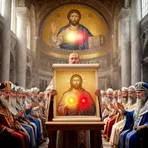
A church council in 680 and 681 that says Christ has a divine will and a human will
Surface Forms
Morphology
Constantinople + (Sixth + ecumenical + Council)
This is a compositional place–event label: 'Constantinople' (the city) + 'Sixth' (ordinal) + 'ecumenical' (church-wide) + 'council' (assembly) directly yield the meaning 'the sixth ecumenical council held in Constantinople'. While specific doctrinal details (dates or theological rulings) are encyclopedic and not derivable, the basic referent and structure are transparent to a learner who knows the constituent words.
Etymology
Constantinople (Sixth Ecumenical Council) was a meeting of Christian leaders in 680–681 in the city of Constantinople where they decided that Christ has 'two wills', one divine and one human. That's why this council's name is used for the decision that rejected 'Monothelitism' (the idea that Christ had only one will).