

ecumenical
 10
8.6
10
8.6

- adjective
- /ˌɛkjuˈmɛnɪkəl/
- Formal
- My purpose is to encourage indigenous representation in ecumenical and interfaith dialogues that address sustainability issues.
- ecumenical movement
- Ecumenical Council
- ecumenical dialogue
Loading YouTube…
Watch on YouTubeThey give a sort of an ecumenical indifference.
- They give a sort of an ecumenical indifference.
Examples
-
Therefore, they are often wary of ecumenical efforts and cooperation with other religious bodies.
Academic text (2011) -
There must be recognition that such ecumenical reception is an ongoing process over years and not minutes.
Academic text (2013) -
I think that the biggest challenge to the ecumenical movement is its own success.
Academic text (2015) -
The next generation is being presented with such a window of ecumenical opportunity!
Academic text (2015) -
I would like to reflect on the following areas: the ecumenical movement, and justice and peace.
Academic text (2015) -
Root has pointed out that the modern ecumenical movement is driven by a contradiction.
Academic text (2015) -
From the beginning of the ecumenical movement, the goal of full visible unity has receded considerably.
Academic text (2015) -
And to strengthen this new Christian tradition, Constantine held a famous ecumenical gathering known as the Council of Nicaea.
-
The church leaders gathered for an ecumenical meeting to discuss ways to promote unity among different Christian communities.
-
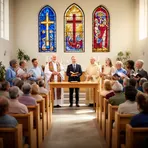
An ecumenical service was held to celebrate the collaboration between diverse faith traditions.
Synonyms
 24
4.5
24
4.5
About events or groups that include people from different religions
 2
6.5
2
6.5
About people or activities from different religions
 1
7.9
1
7.9
Shared by people from different churches or religious groups

 1
4.6
1
4.6
Including people or practices from more than one religion

Relating to work to bring different Christian churches together
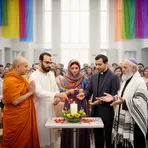
It happens when different churches work together for services or events

Involving people from different religions
Antonyms


Compounds

- Formal
1
9.1
A formal meeting of church leaders from across the Christian world to decide religious beliefs and rules


- Specialized
A meeting of church leaders in 680–681 that says Christ has two wills, divine and human
How Ecumenical

Surface Forms
Morphology
ecumenical = ecumenic (opaque) = ecumen + ical
For the religious sense, learners cannot reliably deduce the meaning from the unfamiliar combining form 'ecumen-' and the adjectival suffix.
Etymology
Ecumenical comes from the Greek oikoumenē, 'the inhabited world', and church writers used it to mean 'for all Christians'. So an ecumenical movement is one that seeks unity among different churches and, more broadly, between religions.