
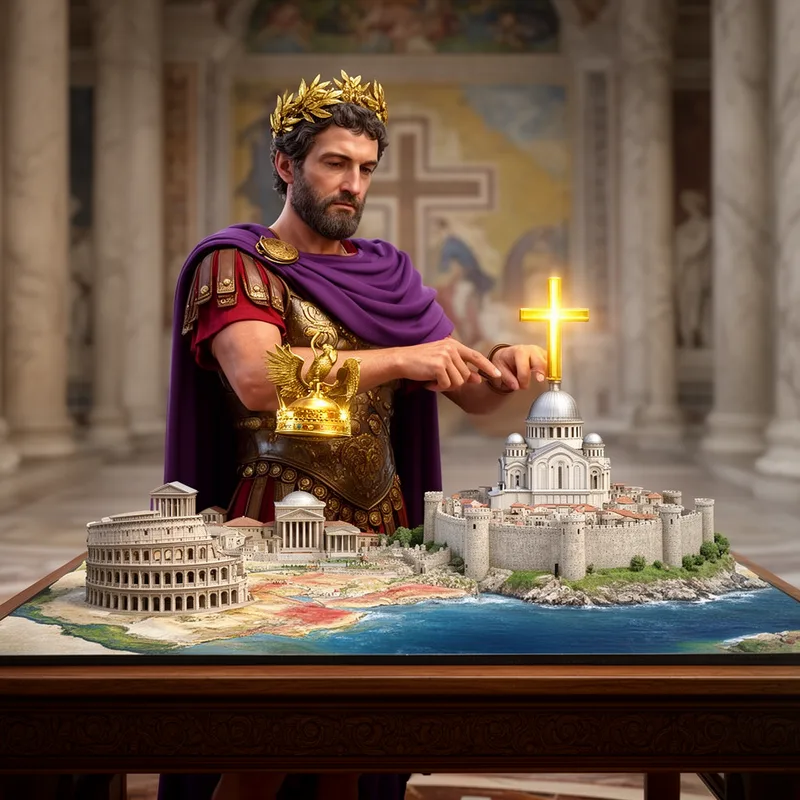
Constantine I
- proper noun
- /ˈkɒnstəntaɪn aɪ/
- Constantine I established Christianity as the official religion of the Roman Empire during his reign.
Examples
-
Constantine I is known for his role in making Christianity the dominant religion of the Roman Empire.
-
After Constantine I moved the capital, Byzantium became known as Constantinople.
-
Many historians consider Constantine I one of the most influential Roman emperors.
-
Constantine I was a pivotal figure in Roman history.
-
Did Constantine I really end the persecution of Christians?
-
After his reign, Constantine I was remembered for moving the capital of the empire to Byzantium.
-
Historians often discuss Constantine I when examining the transition of Rome into a Christian empire.
Synonyms

 25
7.2
25
7.2

A Roman emperor who ends persecution of Christians and makes Christianity the empire's religion

Roman emperor who stopped attacks on Christians, made Christianity the main religion, and moved the capital to Constantinople
Surface Forms
Morphology
Constantine + I
This is a proper name combined with a regnal numeral meaning 'the first' (i.e. 'Constantine the First'), so the overall meaning is compositionally derived from its parts. Regnal numbering is a common, cross-linguistic convention, making the phrase immediately understandable to a learner who knows the constituent items.
Etymology
Constantine I comes from the Latin name Constantinus, which means 'steady' or 'constant'. He was a Roman emperor who ended the persecution of Christians and made Christianity the main religion of the empire. He also moved the capital to Byzantium and renamed it Constantinople, so his name helps you remember the lasting changes he made.