
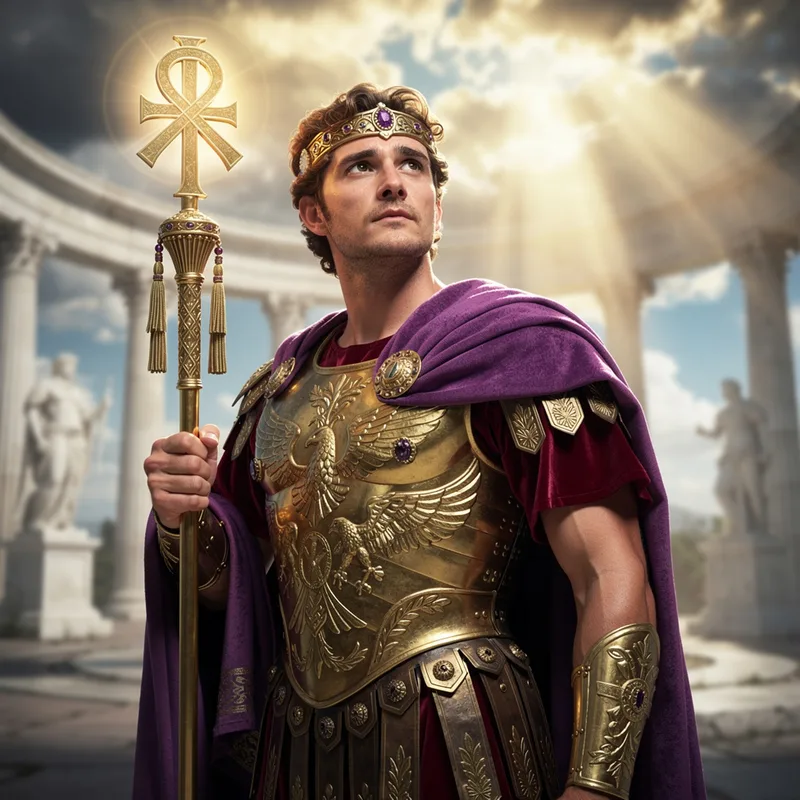
Constantine
 25
7.2
25
7.2

- proper noun
- /ˈkɒnstəntaɪn/
- Over the space of the next 10 years, Constantine gradually made Christianity the official state religion.
- Emperor Constantine
- the reign of Constantine
- Constantine's conversion
Loading YouTube…
Watch on YouTubeSo Constantine was baptized just before he died.
- So Constantine was baptized just before he died.
- That's where it started was Istanbul with Constantine.
- He did not have that awe inspiring splendor of Diocletian or Constantine, for example.
- And then Constantine comes along and says, Nope, we've got an empire to preserve here.
- That's why, you know, Constantine took it up as as as a symbol of the cross to go into battle under.
- Their fortunes changed when Constantine the Great arose as emperor of both East and West and legalized their faith.
- And then Constantine, who was an elite, had an experience and made Christianity to state religion.
- Once you have Constantine come on the scene and basically took up Christianity as the the the religion of of the of the Kingdom.
- Now, that doesn't mean that Constantine became some sort of monk.
Examples
-
The Council of Nicaea in 325 AD was convened by Constantine to address controversial issues in Christianity.
-
Their fortunes changed when Constantine the Great arose as emperor of both East and West and legalized their faith.
-
I thought Constantine was a Christian.
-
Who was the Emperor Constantine?
-
The Emperor Constantine built it as a reservoir 1,600 years ago.
-
Roman emperor, Constantine, changed things when he formed Christianity into a state religion through his council of Nicaea in 325.
-
And to strengthen this new Christian tradition, Constantine held a famous ecumenical gathering known as the Council of Nicaea.
-
For example, the globalization of Christianity started with the conversion of Emperor Constantine I of Rome in 313 A.D.
Academic text (1999) -
In 313 AD, Emperor Constantine issued the Edict of Milan, which granted religious tolerance to Christians.
-
Emperor Constantine founded Constantinople, which became the capital of the Eastern Roman Empire.
Synonyms
Roman emperor who made Christianity the main religion and moved the capital to Constantinople
Roman emperor who stopped attacks on Christians, made Christianity the main religion, and moved the capital to Constantinople
Surface Forms
Etymology
The name Constantine comes from Latin constans, which means 'standing firm' and is the same root as the English word constant. That meaning helps you remember the emperor as someone who 'stood firm' on big choices, like supporting Christianity and founding a new capital.