
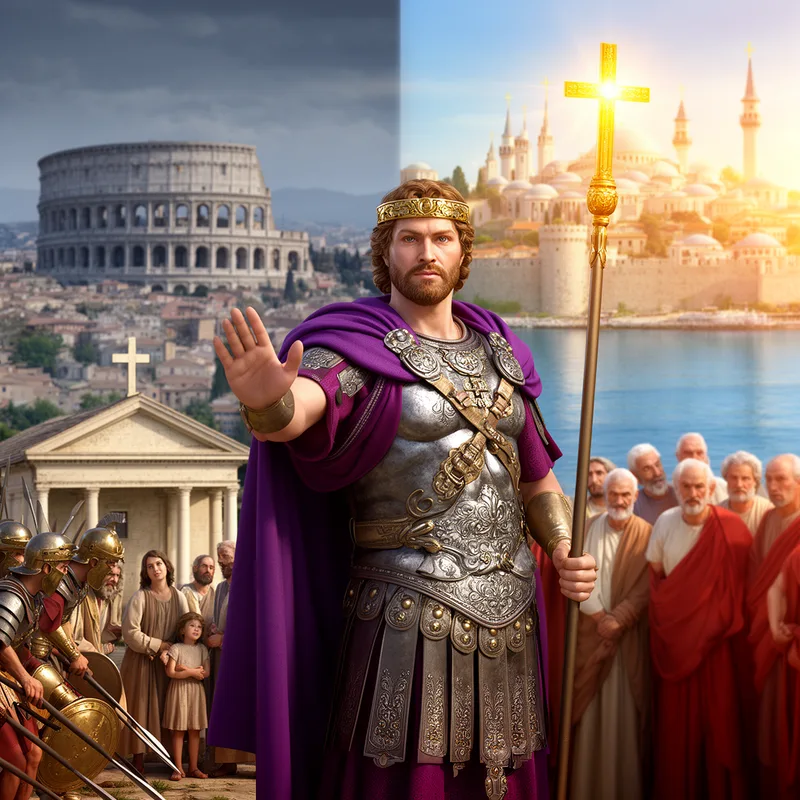
Constantine the Great
- proper noun
- /ˈkɒnstəntaɪn ðə ɡreɪt/
- Constantine the Great is credited with ending the persecution of Christians in the Roman Empire.
Examples
-
Many historians believe that Constantine the Great's conversion to Christianity changed the course of Western history.
-
The city of Constantinople was named by Constantine the Great after moving the capital from Rome.
-
Constantine the Great was a Roman Emperor.
-
Many historians consider Constantine the Great a pivotal figure in Roman history.
-
Constantine the Great is known for making Christianity the official religion of the Roman Empire.
-
Historians regard Constantine the Great as a key figure in the establishment of Constantinople as a major city.
-
The reign of Constantine the Great marked a significant shift in the religious landscape of the Roman Empire.
Synonyms

 25
7.2
25
7.2

A Roman emperor who ends persecution of Christians and makes Christianity the empire's religion

Roman emperor who made Christianity the main religion and moved the capital to Constantinople
Surface Forms
Morphology
Constantine + the + great
The epithet 'the Great' is compositional and signals that Constantine is a distinguished or famous person, so a B1 learner who knows the name and the adjective 'great' can infer that this refers to an important/honoured Constantine. However, the specific historical details (that he was a Roman emperor who stopped persecutions, made Christianity official, and moved the capital) are not derivable from the constituents, so the full encyclopedic meaning is not predictable.
Etymology
Constantine the Great is remembered for a clear story: before a big battle he saw a cross in the sky and thought it would help him win, so he began to support Christians and stopped their persecution. He also moved the capital to Byzantium and renamed it Constantinople, which helped 'make Christianity the official religion' across the Roman Empire.