
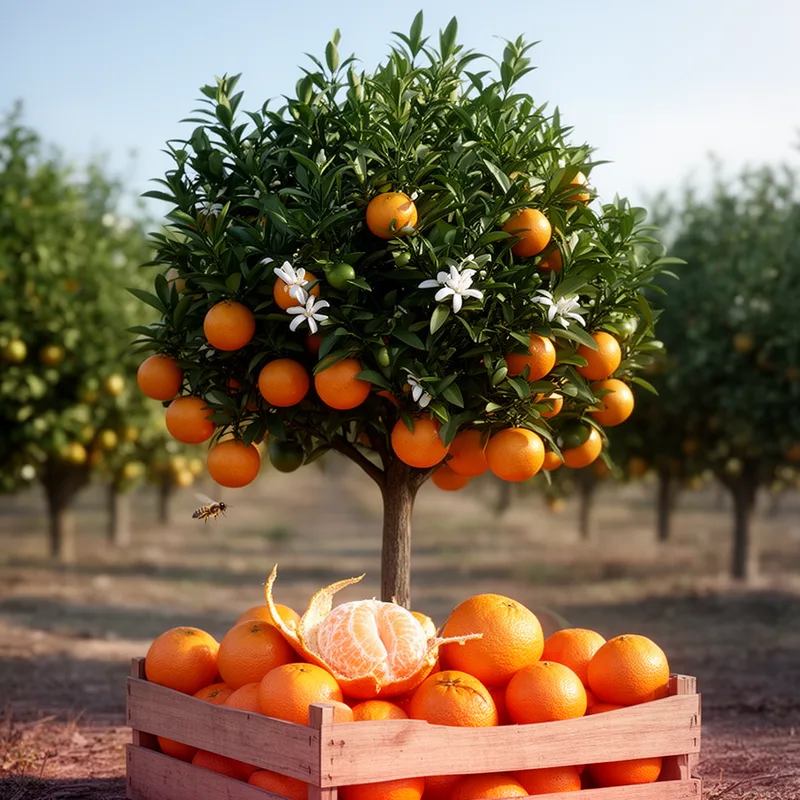
Citrus reticulata
- noun
- Specialized
- Many commercial orchards grow Citrus reticulata for its sweet, easy-to-peel fruit.
Examples
-
The fragrant blossoms of Citrus reticulata attract a variety of pollinators in the spring.
-
The Citrus reticulata tree thrives in warm climates.
-
Researchers studied the fruit of Citrus reticulata for its high vitamin C content.
-
Many gardeners prefer Citrus reticulata for its sweet fruit.
-
Many commercial orchards grow Citrus reticulata for its sweet, easy-to-peel fruit.
-
The fragrant blossoms of Citrus reticulata attract a variety of pollinators in the spring.
-
Many gardeners prefer Citrus reticulata for its sweet fruit.
Synonyms

 5
1.3
5
1.3

A small sweet orange fruit with loose skin you peel
 1
2.3
1
2.3
A small sweet orange fruit that is easy to peel
A small tree from Southeast Asia that grows sweet, easy-to-peel orange fruit
Surface Forms
Morphology
Citrus + reticulata
The first element 'Citrus' clearly signals a citrus genus so a B1 learner would infer it names a kind of citrus plant, but 'reticulata' is a Latin species epithet (not a standard English word and absent from the provided dictionary entry) so the specific sense (mandarin/flattened globose fruit) is not derivable. Botanical binomials are partially informative (genus level) but require specialized or lexical knowledge of the epithet to reach the full meaning, making the expression only partially transparent.
Etymology
Citrus reticulata is a scientific name made of Citrus, the citrus fruit group, and reticulata, a word meaning 'net-like'. It likely refers to the fruit's thin, easily removed skin with a fine net of lines and its many small segments, so the name points to the sweet, 'easy to peel' 'mandarin'.