

Cinchona pubescens
- noun
- Specialized
- The bark of Cinchona pubescens has historically been used to treat malaria.
Examples
-
The Cinchona pubescens tree is native to Ecuador.
-
The hillside was covered with blooming Cinchona pubescens during spring.
-
Botanists study Cinchona pubescens for its important alkaloids.
-
Farmers in Peru cultivate Cinchona pubescens for its medicinal properties.
-
The bark of Cinchona pubescens has historically been used to treat malaria.
-
Farmers in Peru cultivate Cinchona pubescens for its medicinal properties.
-
Botanists study Cinchona pubescens for its important alkaloids.
Synonyms

A small South American tree with shiny leaves and pink flowers whose bark gives quinine
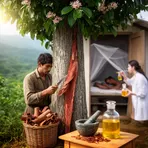
A South American tree whose bark gives a medicine for malaria
Surface Forms
Morphology
cinchona + pubescens
This is a scientific binomial combining the genus name 'Cinchona' with the Latin epithet 'pubescens'; a learner who knows both parts could infer it denotes a particular Cinchona species and that 'pubescens' describes a trait (cf. 'pubescent' = hairy). However, the Latin epithet is technical/not in ordinary dictionaries and the full species sense (native range, medicinal properties) is not directly derivable, so the transparency is partial.
Etymology
Cinchona pubescens comes from a memorable story: Cinchona may be named after the Countess of Chinchón, who helped bring the tree's fever-treating bark to Europe, and pubescens is Latin for 'covered in soft hairs', a nod to the tree's fuzzy young leaves. So, the name points both to the bark's history as a medicine and to the plant's hairy leaves.

