

Christian era
 1
3.0
1
3.0

- noun
- /ˈkrɪs.tʃən ˈɪr.ə/
- The construction of the famous church took place in the Christian era, marking an important architectural achievement.
- the beginning of the Christian era
- centuries of the Christian era
- the early Christian era
Loading YouTube…
Watch on YouTubeNow, nowadays we're talking about the, you know, very early, what we now typically call the Christian era or Common era.
- Now, nowadays we're talking about the, you know, very early, what we now typically call the Christian era or Common era.
Examples
-
1492 was without a doubt the first universal benchmark since the birth of the Christian era.
Academic text (1992) -
As humankind approaches the end of the second millennium of the Christian era, apocalyptic movements are on the rise.
Academic text (1996) -
Most of the lower city's plan goes back to the first two centuries of the Christian era.
Academic text (2004) -
Any institution which has half a thousand years, one quarter of the Christian era stretching behind it, is bound to have a sense of the past.
-
Artistic traditions from the Viking Age persisted into the early Christian era.
Academic text (2000) -
Amid all the vacillations of the Christian era, there exists an inclining scope of moral understanding.
Academic text (2010) -
These religions appeared in the early centuries of the Christian era (Muntz, p. 130).
Academic text (2007) -
In the early Christian era, the cult of Mary gradually replaced the worship of Aphrodite and other earth goddesses, despite papal prohibitions against Mariolatry.
Academic text (2016) -
Historians often study the significant events that shaped the world during the Christian era.
-
Many cultural traditions that we observe today originated in the Christian era and reflect the beliefs of that time.
Synonyms


 1
4.6
1
4.6
The years of history starting at year one of the calendar now used in many countries

Years counted from year 1 in the calendar used today

Marks a year as after the birth of Jesus, often written AD
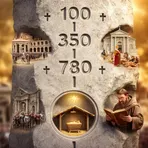
Put before a year to show the date is after Jesus's birth
Surface Forms
Morphology
The meaning is directly composed from 'Christian' (relating to Christianity) and 'era' (a time period), so a learner who knows both words can infer it refers to the historical period defined by Christianity or from the birth of Christ. This construction is cross-linguistically common (e.g., Spanish 'era cristiana', French 'ère chrétienne') and follows regular noun–noun meaning composition, making it readily understandable at B1.
Etymology
Christian era comes from early church scholars who began to count years from the birth of Jesus, making a new era that started at 'year 1'. That's why the phrase now means the period of history measured from that starting point and is used in calendars as 'AD' or 'CE'.