

Anno Domini
- noun
- /ˈæn.oʊ ˈdɑː.mɪ.ni/
- "Varldsundret Anno Domini 1921" is one of the earliest of Diktonius's long poems.
- Anno Domini 1921
Examples
-
Pope John XXII, having ascended to heaven by way of Avignon, Anno Domini 1334, we think his estate might be worth mentioning.
Fiction book (1991) -
"The World Wonder Anno Domini 1921:"
Academic text (1997) -
Anno Domini.
-
The battle took place in 1175 Anno Domini, marking a significant event in medieval history.
-
In 450 Anno Domini, the Western Roman Empire faced numerous invasions from barbarian tribes.
-
Historians often reference the year 800 Anno Domini as the moment Charlemagne was crowned Emperor.
Synonyms

 6
8.2
6
8.2

The year in the Christian calendar used when writing dates like AD 1865
 1
3.0
1
3.0
A time starting at Jesus's birth that people use for AD or CE dates


 1
4.6
1
4.6
The years of history starting at year one of the calendar now used in many countries

Put before a year to show it is after the birth of Jesus
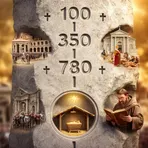
Put before a year to show the date is after Jesus's birth

Years counted from year 1 in the calendar used today

Used to mark years in the Common Era, like A.D
Surface Forms
Morphology
Anno + dominus
The Latin constituents literally yield 'year' (anno) + 'lord' (dominus), so a learner who knows those parts can infer a meaning like 'year of the Lord' that relates to a calendar era. However, the phrase is Latin and requires cultural/historical knowledge to link 'the Lord' specifically to Christ and to the AD dating convention, so the meaning is not fully predictable for a typical B1 learner.
Etymology
Anno Domini comes from Latin and means Anno 'year' of Domini 'the Lord'. People used Anno Domini to mark years after Jesus's birth, so a date with Anno Domini shows the year is 'after' that event.