

Battle of Verdun


 1
8.2
1
8.2
- proper noun
- The Battle of Verdun, that other great disaster of 1916, had occluded the Battle of the Somme in France, despite the fact that the French lost 200,000 men in the latter battle.
Loading YouTube…
Watch on YouTubeThat also happened this week at Verdun to begin the Battle of Verdun.
- That also happened this week at Verdun to begin the Battle of Verdun.
Examples
-
Efforts were mainly by France in the Allied front; America did not help. Two million French soldiers were lost, and one million British and two million Germans. Most battles were won by France, such as the Battle of the Somme and the Battle of Verdun.
Blog text (16) -
The Battle of Verdun was one of the longest and bloodiest confrontations of World War I, leading to immense casualties on both sides.
-
During the Battle of Verdun in 1916, French and German forces fought fiercely for control over the strategic city.
-
In 1916, the Battle of Verdun became a symbol of French determination in World War I, as it marked a significant and grueling fight against German offensives.
Synonyms
 2
8.3
2
8.3
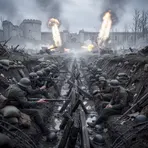
A long, deadly battle in 1916 between French and German armies during World War I
How Bloody

Surface Forms
Morphology
The meaning is directly compositional: 'battle' (armed fight) + 'of' (indicating location/association) + the place name 'Verdun' yields 'a battle that took place at Verdun.' The 'Battle of X' construction is cross-linguistically common and follows a standard noun + preposition + place pattern, so a B1 learner who knows the constituents would readily infer the meaning.
Etymology
Battle of Verdun is named after the town of Verdun in France, where French and German armies fought around old forts and long lines of trenches for many months. Because the fighting was so fierce and very bloody, the name now makes people think of a 'long' and 'deadly' battle.