
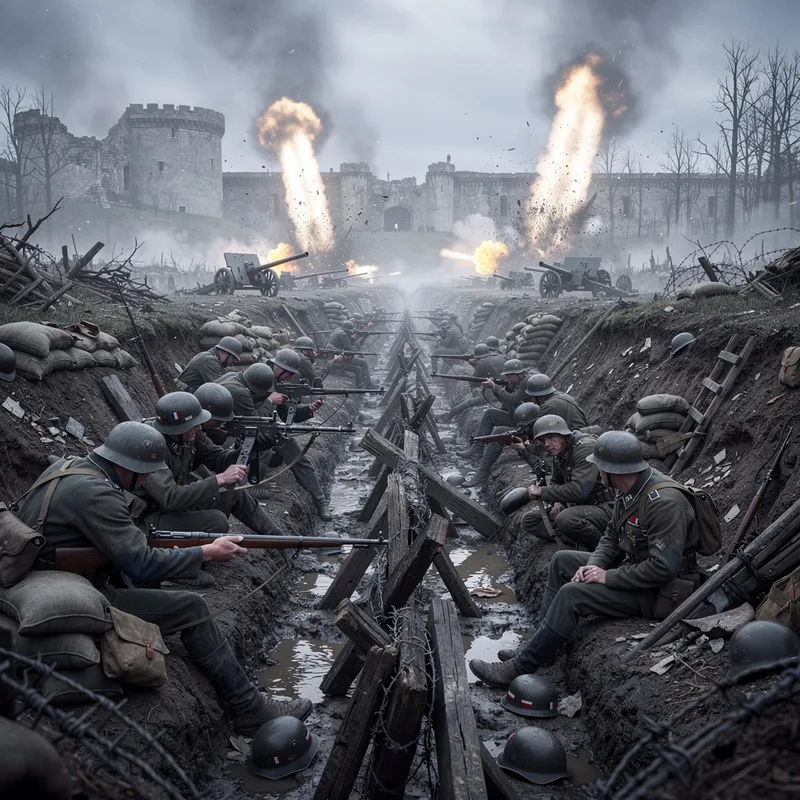
Verdun
 2
8.3
2
8.3

- proper noun
- /vɛrˈdʌn/
- In 1916, the French forces defended Verdun against a relentless German attack.
- Battle of Verdun
Loading YouTube…
Watch on YouTubeThing is, it doesn't seem like Verdun was actually an end to itself.
- Thing is, it doesn't seem like Verdun was actually an end to itself.
- That also happened this week at Verdun to begin the Battle of Verdun.
Examples
-
The Battle of Verdun, that other great disaster of 1916, had occluded the Battle of the Somme in France, despite the fact that the French lost 200,000 men in the latter battle.
Academic text (2001) -
The battle of Verdun was fought over 6 months ago.
-
Verdun was a "battle" that lasted ten months and killed almost a million men.
Fiction book (1991) -
With over a million casualties from the Battle of Verdun alone, the death toll continues to climb.
-
As if the draft was not enough, 1916 also saw the Battle of the Somme and the Battle at Verdun, two of the most costly battles of the war.
Academic text (2002) -
The Battle of Verdun lasted for several months and resulted in enormous casualties on both sides.
-
The strategy used at Verdun became a crucial part of military history due to its impact on World War I.
Synonyms

 1
8.2
1
8.2
A major World War I battle in 1916 near Verdun, France between French and German armies
Compounds
1
8.2
A major World War I battle in 1916 near Verdun, France between French and German armies
Surface Forms
Etymology
Verdun is the name of a French town and likely comes from old words where ver meant 'green' and dun meant 'hill' or 'fort'. So you can remember Verdun as the 'green fort'—a strong place that became famous as the site of a long, deadly battle in World War I.