

Aramaic script


 1
9.8
1
9.8
- noun
- /ˈærəˌmeɪɪk skrɪpt/
- Specialized
- Scholars have discovered ancient texts written in Aramaic script in archaeological sites across the region.
Examples
-
The Aramaic script was widely used in ancient Persia.
-
The Aramaic script was influential in the development of several Middle Eastern alphabets.
-
Many modern scripts, such as Hebrew and Arabic, can trace their origins to the Aramaic script.
-
Many historical documents are written in Aramaic scripts.
-
The museum has a collection of ancient artifacts that include inscriptions in Aramaic script.
-
Scholars study Aramaic script to understand the history of the Aramaic language.
-
Many historical texts were written in Aramaic script, providing insight into ancient cultures.
Synonyms
 1
9.4
1
9.4
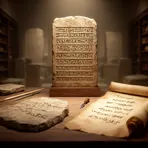
A writing system used from about the 9th century BC to write Aramaic and form later scripts
Surface Forms
Morphology
The phrase combines a language name 'Aramaic' with the noun 'script' (writing system), so its meaning — the writing system used for Aramaic — is directly derivable from the constituents. This kind of language-name + script composition is cross-linguistically common and follows a transparent, compositional pattern that a B1 learner who knows both words would understand.
Etymology
The Aramaic script started as a set of simple letter shapes used by traders and officials who wrote on clay and other materials across the Middle East. Because people copied and changed those letters, they became the basis for many later alphabets, so Aramaic script is the early 'writing system' behind scripts like Hebrew and Arabic.