
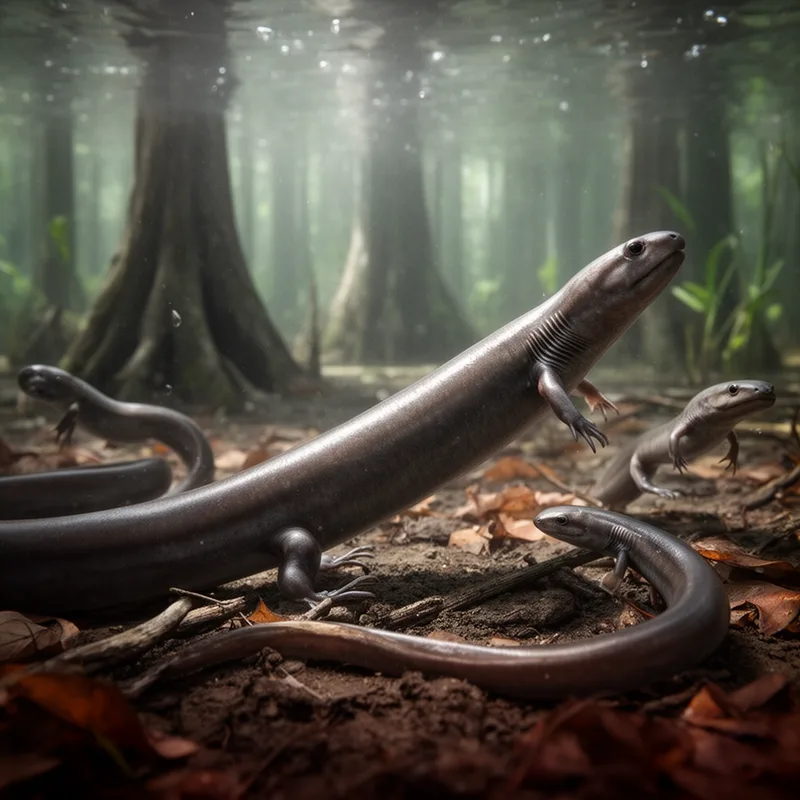
Amphiumidae
- noun
- /æmˈfjuːɪˌmeɪdi/
- Specialized
- The Amphiumidae are a family of eel-like salamanders found in the southeastern United States.
Examples
-
The Amphiumidae are fascinating aquatic salamanders that thrive in freshwater swamps and lakes.
-
The Amphiumidae family includes several species of aquatic salamanders.
-
Herpetologists often debate the evolutionary origins of the Amphiumidae due to their unusual limb structure.
-
Scientists studying the Amphiumidae have discovered their unique method of respiration in low-oxygen waters.
-
Have you ever seen an Amphiumidae in the wild?
-
Many people are surprised to learn that Amphiumidae can grow over three feet long in some species.
-
The Amphiumidae adapt well to their environment with their long bodies and reduced limbs.
Synonyms

A large water salamander that has a long eel-like body, tiny legs, and lives in swamps

A long thin water animal like an eel with tiny legs that lives in muddy pools in the southern US

A thin water animal that looks like an eel and has two pairs of legs that lives in muddy water
Surface Forms
Morphology
Amphiumidae = Amphiuma (opaque) = Amphiuma + idae
The formation uses the specialized Latin taxonomic suffix '-idae' (family), which is not a productive or familiar English morpheme for average learners, so the meaning 'family of salamanders' is not derivable from everyday knowledge.
Etymology
Amphiumidae comes from the animal name Amphiuma, built from the Greek part amphi- meaning 'both' and the ending -idae meaning 'family' in animal names. A helpful way to remember it is that these creatures look like both eels and salamanders, so the name fits the family today.

