
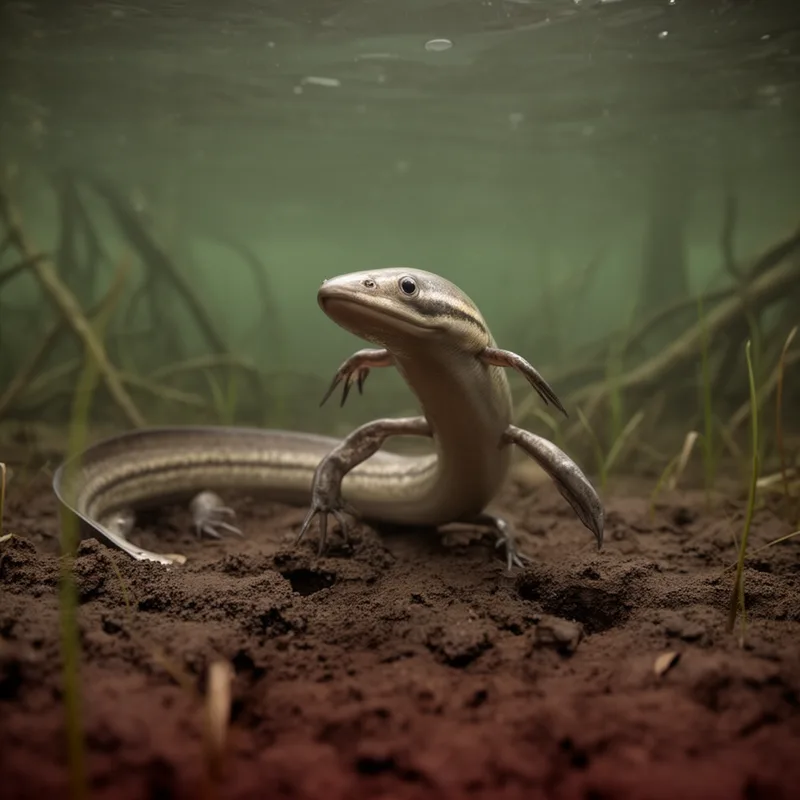
congo eel
- noun
- /ˈkɒŋɡoʊ iːl/
- US
- The congo eel is rarely seen during the day as it hides in mud at the bottom of swamps.
Examples
-
The biology class visited the bayou to observe the elusive congo eel in its natural habitat.
-
The congo eel is often found in muddy waters.
-
Local fishermen sometimes catch a congo eel while setting traps for catfish.
-
Have you ever seen a congo eel?
-
Local fishermen sometimes catch a congo eel while setting traps for catfish.
-
The congo eel is rarely seen during the day as it hides in mud at the bottom of swamps.
-
The biology class visited the bayou to observe the elusive congo eel in its natural habitat.
Synonyms

A long thin water animal like an eel with tiny legs that lives in muddy pools in the southern US

A small eel-like animal with tiny legs and small eyes that lives in muddy water

A large water salamander that has a long eel-like body, tiny legs, and lives in swamps
Surface Forms
Morphology
A B1 learner who knows 'Congo' and 'eel' would likely infer a fish-like animal from the Congo region, but the actual referent is an eel-shaped salamander found in the southern United States. The geographic and taxonomic mismatch means the overall meaning cannot be reliably derived from the constituents, so the expression is idiomatic/lexicalized rather than compositional.
Etymology
Congo eel likely comes from two pictures: congo giving a sense of a distant, wild water place and eel showing its long, thin, snake-like body. Although it is 'not a true eel', it is a slim, eel-shaped salamander that lives in still, muddy water, so the name helps you picture its shape and home.

