
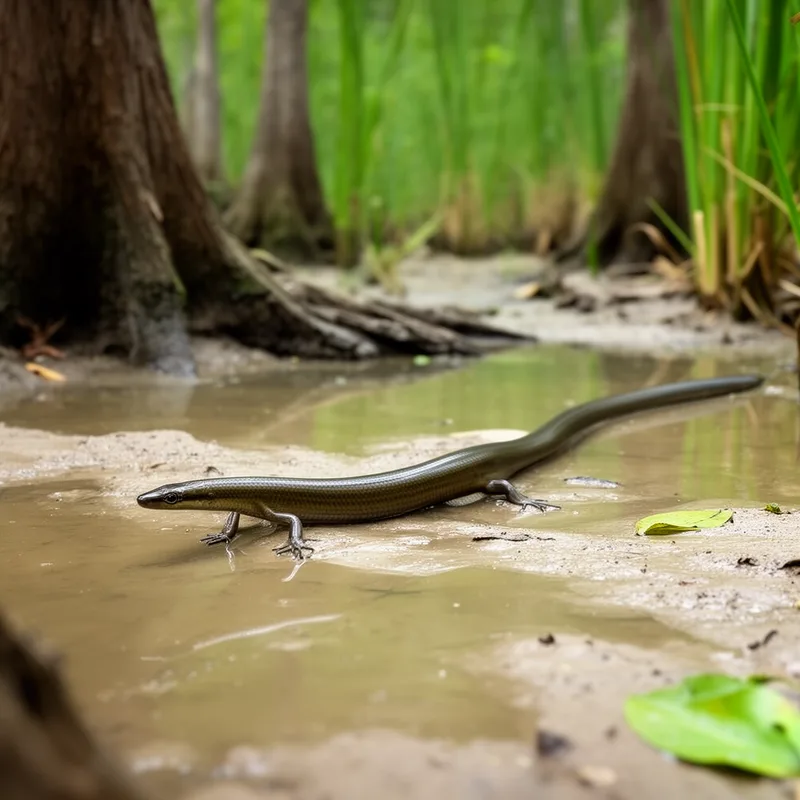
congo snake
- noun
- US
- We spotted a congo snake gliding silently through the murky water near the riverbank.
Examples
-
The biology textbook includes an illustration of the congo snake and its unique small limbs.
-
The congo snake is often found in muddy waters.
-
During the field trip, researchers carefully captured a congo snake for detailed observation.
-
Have you ever seen a congo snake in the wild?
-
During the field trip, researchers carefully captured a congo snake for detailed observation.
-
The biology textbook includes an illustration of the congo snake and its unique small limbs.
-
We spotted a congo snake gliding silently through the murky water near the riverbank.
Synonyms

A thin water animal that looks like an eel and has two pairs of legs that lives in muddy water

A large water salamander that has a long eel-like body, tiny legs, and lives in swamps

A small eel-like animal with tiny legs and small eyes that lives in muddy water
Surface Forms
Morphology
congo + snake
Although the form looks like a straightforward place-name + animal compound (e.g. 'Congo' + 'snake'), a B1 learner who knows the constituents would plausibly infer a reptile from Congo. The listed meaning, however, refers to an aquatic eel‑shaped salamander (not a snake) and the element 'congo' is not defined here, so the actual sense cannot be reliably derived from the parts.
Etymology
The name congo snake may come from how this long, eel-like animal looks and moves like a small snake, while the word congo was probably added as a local name. Because people saw something that looked like a snake but was actually a 'salamander', the name came to mean this particular water creature.

