

zoopraxiscope
- noun
- /ˌzuːoʊˈpræksɪˌskoʊp/
- Archaic
- Historians consider the zoopraxiscope an important step in the development of cinema technology.
Examples
-
The zoopraxiscope was invented in the late 19th century.
-
The zoopraxiscope was invented in the 19th century to demonstrate moving images to audiences.
-
At the exhibition, visitors watched a short film projected by a restored zoopraxiscope.
-
Have you ever seen a zoopraxiscope in action?
-
The zoopraxiscope is often credited as an early device that projected images to create the illusion of moving pictures.
-
Using the zoopraxiscope, viewers could see a series of images in motion, making it a precursor to modern cinema.
-
The invention of the zoopraxiscope allowed people to experience animated sequences long before the advent of film.
Synonyms

 2
2.7
2
2.7

A machine that shows films on a screen for groups of people
 1
9.9
1
9.9
A rotating cylinder with pictures that look like they move when seen through narrow slits


 1
9.9
1
9.9
A machine long ago used to record and show moving pictures
 1
9.9
1
9.9
An early machine that shows moving pictures to people

A machine that shows moving pictures from film on a screen

An early projector that shows moving pictures
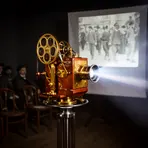
An early machine that shows moving pictures on a screen
Surface Forms
Morphology
zoopraxiscope = zoo + praxis + scope
This is a learned technical coinage built from classical combining forms, but the device meaning is not readily recoverable for an average learner from the parts alone.
Etymology
Zoopraxiscope comes from Greek parts zoo- 'animal', praxis 'action' and -scope 'to look'. You can see zoo- like in the word 'zoo' and -scope like in 'telescope'. That's why the name fits an early machine that showed moving pictures of animals and action, and it helps you remember it is a device for showing motion.