
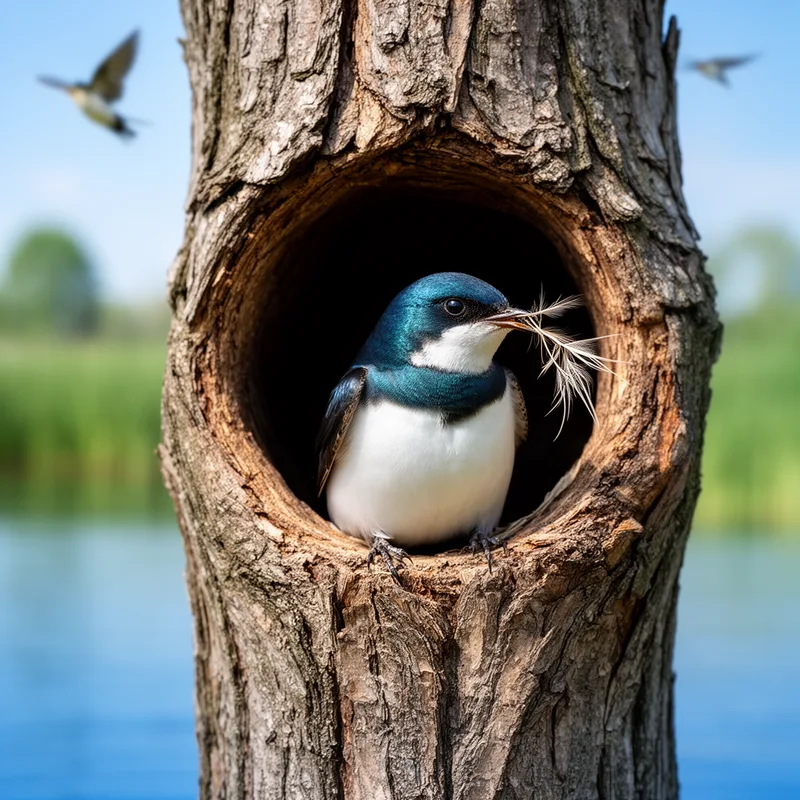
white-bellied swallow
- noun
- /ˈwaɪtˌbɛl.id ˈswɑloʊ/
- US
- Researchers observed a white-bellied swallow building a nest in an old tree cavity.
Examples
-
The white-bellied swallow is commonly seen near lakes and rivers during the summer months.
-
A flock of white-bellied swallows darted across the open field catching insects in mid-air.
-
The white-bellied swallow is often seen near water.
-
Many white-bellied swallows migrate south for the winter.
-
A flock of white-bellied swallows darted across the open field catching insects in mid-air.
-
Researchers observed a white-bellied swallow building a nest in an old tree cavity.
-
The white-bellied swallow is commonly seen near lakes and rivers during the summer months.
Synonyms

A small swallow with a blue-green back and white belly that nests in tree holes
A small North American bird with shiny blue-green back and white belly that nests in tree holes
Surface Forms
Morphology
white-bellied + swallow
The phrase is fully compositional: 'white-bellied' means having a white belly and simply modifies 'swallow', so the combined meaning is a swallow with a white-colored belly. This kind of descriptive compound is cross-linguistically common and follows regular adjective+noun composition, so a B1 learner who knows the constituent words can infer the meaning.
Etymology
White-bellied swallow comes from a simple picture: a white-bellied (a bird with a white belly) swallow (a small bird) with a blue-green back that often nests in holes in trees. So, the name simply describes this species, also called the 'tree swallow'.

