
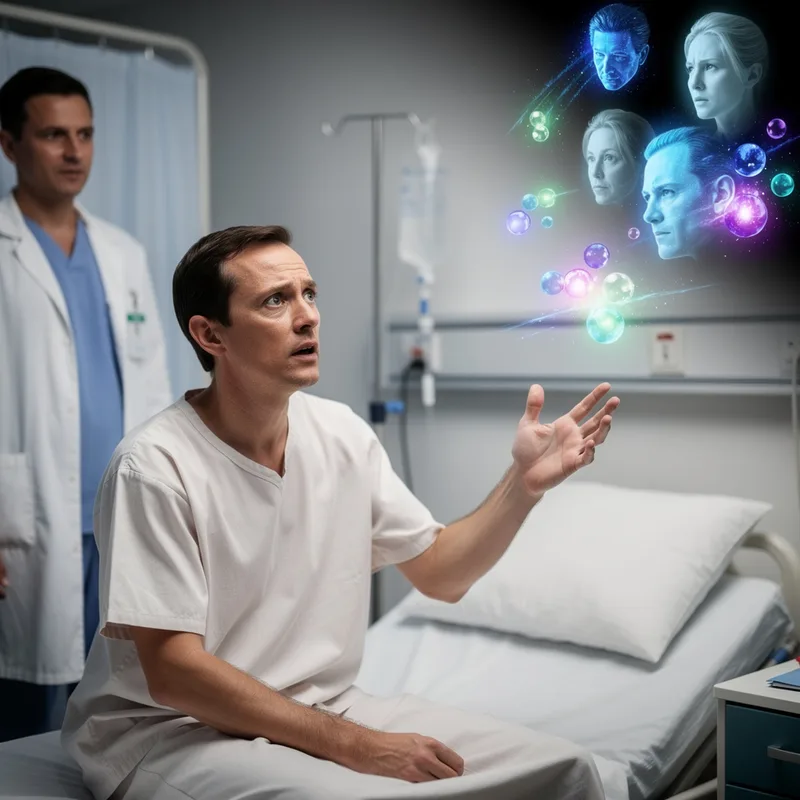
visual hallucination
 1
7.9
1
7.9

- noun
- /ˈvɪʒuəl ˌhæluˈkeɪʃən/
- Specialized
- Characteristically, the hallucinations do not cause emotional perturbation, in stark contrast with the disquiet evoked by the visual hallucinations reported by delirious or psychotic patients.
Examples
-
Thus, extracampine hallucinations complement visual hallucinations as part of the symptoms of dementia with Lewy bodies and Parkinson's disease.
Academic text (2002) -
The visual hallucinations in dementia with Lewy bodies typically involve people of normal size and configuration who do not communicate with the patient.
Academic text (2002) -
I began experiencing auditory and visual hallucinations.
Blog text (11) -
So, the toxic levels of the drug caused practically a malfunction in the brain, and it caused me to have both auditory and visual hallucinations.
Blog text (30) -
Neurodegenerative disorders can be associated with visual hallucinations, particularly dementia with Lewy bodies; indeed, the presence of visual hallucinations constitutes one of the core diagnostic features of this disease.
Academic text (2002) -
Note that epileptic patients who suffer from seizures in the temporal lobes have auditory or visual hallucinations, which they often interpret as mystical experiences.
Academic text (2007) -
After her medication was adjusted, she started to experience visual hallucinations that made her see colorful shapes in her room.
-
Patients with certain mental health conditions may suffer from visual hallucinations, where they perceive things that are not actually there.
-
During his illness, he often confided in his family about the visual hallucinations he encountered while trying to sleep.
Synonyms
 848
3.8
848
3.8
A clear image in the mind of something not present
 140
7.5
140
7.5
A false experience in which you see or hear something not there
 52
4.2
52
4.2
A magic trick that makes something look impossible
 19
8.9
19
8.9
A ghost that people see suddenly
 4
9.9
4
9.9
A thing that seems real but is only in the mind, like a ghost


 1
9.9
1
9.9
A ghost-like figure that seems real but is not
Antonyms
Surface Forms
Morphology
The sense 'an image that appears real but is fabricated or not grounded' is directly and compositionally derived from 'visual' (pertaining to sight) modifying 'hallucination' (a false or illusory perception), so a learner who knows both words can infer the meaning. Even in the AI-specific usage the extension is straightforward (a sight-related false output), and this compositional pattern is cross-linguistically common, making it immediately comprehensible to B1 learners.
Etymology
Visual hallucination combines visual, meaning 'seeing', and hallucination, a picture your mind makes that is not real. Imagine a person seeing faces in the shadows like a waking dream; that's why the term means 'seeing things that are not actually there'.