

unstable
 50
7.0
50
7.0

- adjective
- /ʌnˈsteɪbəl/
- Specialized
- High energy or ionizing radiation is emitted when the unstable atoms of radioactive materials transition to a stable state.
- unstable compound
- highly unstable
Loading YouTube…
Watch on YouTubeThe radioactive compounds are then concentrated in the mineral, but it's an unstable compound that'll crumble away within a few years.
- The radioactive compounds are then concentrated in the mineral, but it's an unstable compound that'll crumble away within a few years.
- Atoms leftover after large unstable nuclei are split to release energy.
- However, neutrons, curiously enough, are actually unstable if they are on their own.
- Energy turns into mass and we can make these brand new unstable particles.
Examples
-
Fusion power is in some sense one of the ultimate sources of energy, but it's unstable and we don't have fusion power today.
-
It's a very poisonous and unstable compound.
-
Turns out the ray is highly unstable.
-
The nitrogen in the air is also unstable, though in less degree.
-
Energy turns into mass and we can make these brand new unstable particles.
-
So a wormhole is highly unstable, wanting to collapse upon itself.
-
Structural engineers take the necessary precautions to secure unstable areas and protect workers in the recovery effort.
Academic text (2001) -
Muons were known to be unstable; laboratory experiments showed them to decay quite rapidly.
Academic text (1992) -
One-celled life had to react almost instantly to an unstable, unsafe environment or die.
Fiction book (2000) -
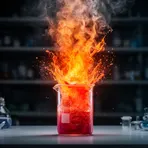
The scientist warned that the chemical was highly unstable and could react violently if mixed with water.
Synonyms
 233
4.6
233
4.6
Able to burst or cause a sudden violent outburst
 77
7.0
77
7.0
Likely to change suddenly and become more dangerous
 5
5.1
5
5.1
Likely to take part in chemical reactions
 1
9.7
1
9.7
Able to change or break down easily

Something very fragile that people or events can easily destroy
Antonyms

How Reactive

Surface Forms
Morphology
Etymology
Unstable is formed from un- 'not' and stable 'standing firm'. So an unstable substance does not 'stand firm' and can change or break apart suddenly, which is why it can be dangerous.