

to turn off
 631
1.3
631
1.3

- phrasal verb
- /tɜrn ɔf/
- He turned off the hose and took me for a walk.
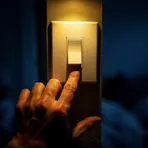
- turn off the lights
- turn off the TV
- turn off the music
Loading YouTube…
Watch on YouTubeAnd then I think I said, Joan, turn off the music.
- And then I think I said, Joan, turn off the music.
- For one thing, you can turn a smart tool off and throw it away.
- But the nice thing is you could turn them off in a few hours.
Examples
-
So why can't I turn off the radio?
-
Oh my gosh, Google, turn off the living room light.
-
You know, if you turn the lights off, it's not that bad.
-
Turn on the two photo lights and turn off all other room lights.
Academic text (1994) -
Before the lecture begins, have students turn off their mobile devices.
Academic text (2017) -
It's been filmed, so please turn off any mobile phones.
-
Suzie turns off the kitchen light and then turns off the dining room light.
Fiction book (1990) -
Ma'am, I'm going to need you to turn your phone off.
-
Please turn off the television before you go to bed.
-
Could you turn off the fan? It's a bit too noisy for my liking.
Synonyms
 620
3.8
620
3.8
To stop something suddenly before it is finished
 541
2.9
541
2.9
Stop a machine, business, or system from working
 87
3.5
87
3.5
Make a device or feature stop working
 83
2.6
83
2.6
Stop something from working by using a switch or valve
 63
3.9
63
3.9
To make a device, system, or account stop working
 37
1.1
37
1.1
To stop a machine or light by using a control such as a button
 36
2.7
36
2.7
To switch off a light or machine
 4
5.8
4
5.8
To make something stop working

To make equipment safe by turning off its power

Remove a device's plug from the socket so it has no power
Antonyms


How Active

Surface Forms
Morphology
The sense 'to repel or cause dislike' is a metaphorical extension of the literal components (turn = change, off = away/switch off) but the emotional/affective meaning is not directly deducible from simple composition. Learners might infer a loss of interest from 'turn off' by analogy with 'switch off', yet the precise sense of causing disgust or aversion typically requires prior exposure, so it is only partially transparent.
Etymology
Turn off comes from turning a switch or knob into the off position so the power stops; you physically turn the control and the machine goes quiet. So it means 'to stop a device'.