
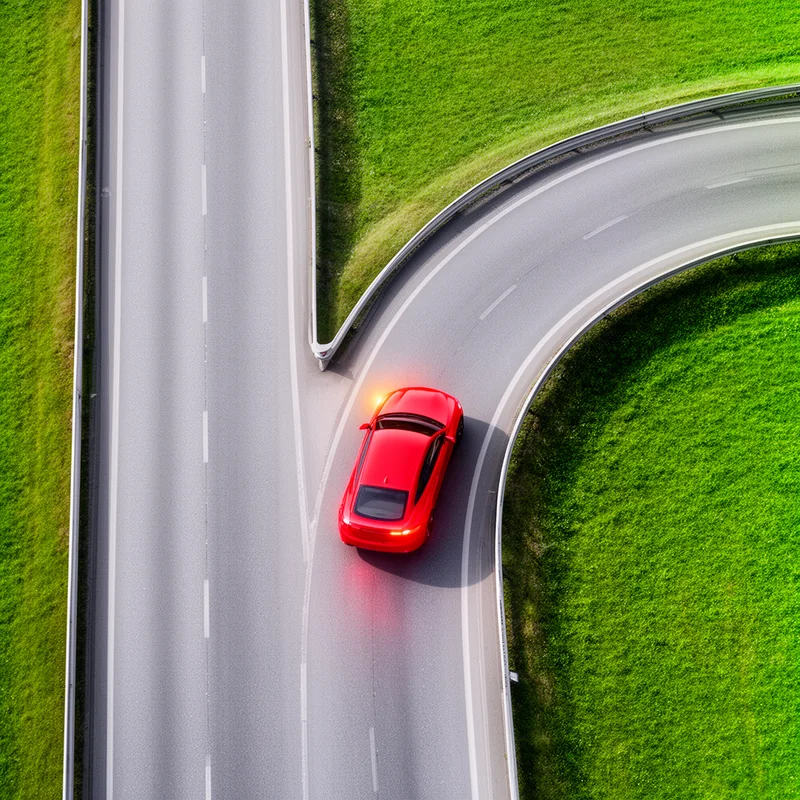
to turn off
 30
1.8
30
1.8

- phrasal verb
- /tɜrn ɔf/
- The bus will turn off the highway at the next exit to reach the local community center.
- turned off the road
- turned off the highway
- turned off Main Street
Loading YouTube…
Watch on YouTubeI asked as we turn left off the road and started down a deserted, bumpy track.
- I asked as we turn left off the road and started down a deserted, bumpy track.
Examples
-
After driving for an hour, we decided to turn off the main road and explore the scenic countryside.
-
Okay, turn off Adams onto Buchanan.
-
- This is where they turned off the road.
-
We had to turn off the main road, and, uh, now we're lost.
-
We passed the woman and turned off the road at a sign that said FAMOUS FISH CAVES.
Fiction book (1991) -
Suddenly, she pulls over to the side of the road, turns off the engine, and gets out of the car.
Fiction book (1990) -
"I think we might turn off here and come back to the road perhaps a mile farther along.
Fiction book (1990) -
They just turned off the road.
-
This is where we turn off for Chukoti.
-
Well, you turn north off the highway about five miles this side of Whitick.
Synonyms
 7
3.1
7
3.1
To move off a road into a driveway or side road
Antonyms

How Far

Surface Forms
Morphology
The sense 'to repel or cause dislike' is a metaphorical extension of the literal components (turn = change, off = away/switch off) but the emotional/affective meaning is not directly deducible from simple composition. Learners might infer a loss of interest from 'turn off' by analogy with 'switch off', yet the precise sense of causing disgust or aversion typically requires prior exposure, so it is only partially transparent.
Etymology
Turn off comes from the simple image of a vehicle making a turn and moving off the main road onto a smaller road. So it means 'to leave a road'.