
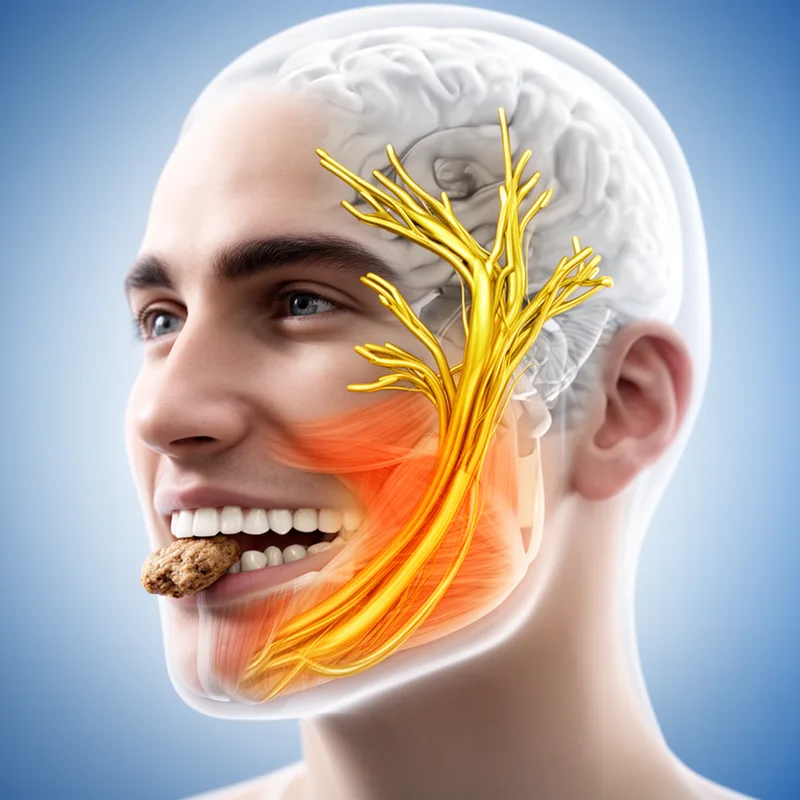
trigeminal


 1
8.6
1
8.6
- adjective
- /traɪˈdʒɛmɪnəl/
- Specialized
- The trigeminal nerve is essential for facial sensation and is involved in the process of chewing.
- trigeminal nerve
- trigeminal neuralgia
- trigeminal neurons
Examples
-
Stimulation of areas innervated by the trigeminal nerve also leads to a stapedial reflex.
Academic text (1998) -
Briefly, the mandibular arch musculature was originally innervated by the post-trematic branch of the trigeminal nerve (cranial nerve V, the mandibular nerve).
Academic text (2003) -
The sensation of pain in the face and head develops through the trigeminal vascular system.
Academic text (2011) -
Some years later, Mohanty et al. reported that trigeminal neuralgia was the most common initial finding.
Academic text (2006) -
Patients frequently consult otolaryngologists for the treatment of trigeminal neuralgia.
Academic text (1996) -
One patient had both left trigeminal neuralgia of the third division and left glossopharyngeal neuralgia.
Academic text (1996) -
Multiple sclerosis is the most common cause, prior to age 50, of trigeminal neuralgia, a particularly painful syndrome (6).
Academic text (2000) -
Notably, the patient's trigeminal nerve sensation was normal in all distributions, and there were no other cranial neuropathies.
Academic text (2004) -
Migraine is an inherited condition that is believed to be a neurological dysfunction involving the trigeminal nerve and the cranial vessels.
Academic text (2011) -
The trigeminal nerve becomes hyperactive and its branches trigger perivascular inflammation and vascular dilation.
Academic text (2011)
Compounds

- Specialized
1
7.5
A sudden, very strong, sharp pain in one side of the face caused by a nerve problem
- Specialized
A nerve in the face that carries feeling and controls chewing muscles
Surface Forms
Morphology
trigeminal = trigeminus (semi-transparent) = tri + gemin + al
The prefix 'tri-' ('three') is clear, but the combining form 'gemin-' is an uncommon Latin medical combining form (not a standalone English word), so the overall meaning ('threefold' → used for the three-branched cranial nerve) is only partly transparent to general learners.
Etymology
Trigeminal comes from the Latin parts tri- ('three') and geminus ('twin'), and it describes things related to the nerve that has three branches in the face. So calling something trigeminal means it is 'about the three-part facial nerve'.