

tricuspid valve
 1
4.8
1
4.8

- noun
- /ˈtraɪkʌspɪd vælv/
- Specialized
- In our case, due to the risk of pulmonary thromboembolism and acute obstruction of the tricuspid valve, emergency surgery was performed although thrombolysis could be the first-line treatment.
Examples
-
Right ventricular overload with reduction in right atrial dimension may be evident with decreased tricuspid valve excursion.
Academic text (2007) -
Because of the risk of pulmonary thromboembolism and acute obstruction of the tricuspid valve, emergency surgery was performed.
Academic text (2007) -
Further investigation revealed a large free serpentine right atrial thrombus, which sometimes prolapsed through the tricuspid valve into the right ventricle.
Academic text (2007) -
During my heart check-up, the doctor explained that the tricuspid valve controls blood flow from the right atrium to the right ventricle.
-
The tricuspid valve prevents blood from flowing backward when the right ventricle contracts.
-
In patients with heart defects, surgery may be needed to repair the tricuspid valve for better blood circulation.
Synonyms
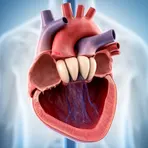
A valve with three flaps between the right upper and lower chambers of the heart that stops blood flowing backward
Surface Forms
Morphology
The compound is directly compositional: 'tricuspid' (three-pointed/three cusps) plus 'valve' (a flow‑control device) yields a valve with three flaps that controls flow. This literal, technical naming is cross‑linguistically regular and thus a B1 learner who knows the constituents can infer the meaning.
Etymology
Tricuspid valve is a name for a heart valve where tri- means 'three' and the valve has three flaps that open and close between two heart chambers to let blood go forward and stop it flowing back, so the name describes both its three parts and its job.