

trade gap
 1
3.8
1
3.8

- noun
- /treɪd ɡæp/
- He noted that China is already America's top customer for soybeans and Boeing aircraft, and that the United States could close the trade gap by selling China advanced military hardware.
- widening trade gap
- narrow the trade gap
- billion trade gap
Examples
-
The trade gap narrowed in the third quarter as exports increased, indicating a potential improvement in the economy.
-
Much of the economic news throughout 2012 has been negative, including two quarters back in recession, a widening trade gap, and most recently during the Games, a revised forecast from the Bank of England that the economy faced zero growth for the year.
Blog text (25) -
The current US trade gap is only about 5% of GDP. If the US is forced to stop running a trade deficit due to a currency collapse, that's a reduction of only 5% of US consumption.
Blog text (23) -
In 2022, the U.S. experienced a significant trade gap, with imports exceeding exports by over $800 billion.
-
Experts predict that reducing the trade gap will require changes in both consumer behavior and international trade policies.
Synonyms
 4
3.9
4
3.9
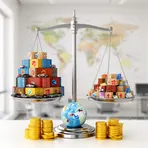
The difference in value between a country's exports and imports of goods
 2
4.4
2
4.4
The difference in value of goods a country sells and buys from other countries over time
Surface Forms
Morphology
The meaning is transparently built from 'trade' (buying and selling) + 'gap' (a difference), so a B1 learner who knows both words can infer it refers to a difference in trade values (e.g., between imports and exports). This is a regular noun+noun composition used in economic contexts and has clear cross-linguistic parallels, making it readily comprehensible without prior exposure.
Etymology
The term trade gap comes from a simple picture of trade as two piles: what a country sells and what it buys, with a clear empty space between them—the gap. That empty space shows the difference between 'imports' and 'exports' and tells if the country has a 'deficit' or a 'surplus'.