
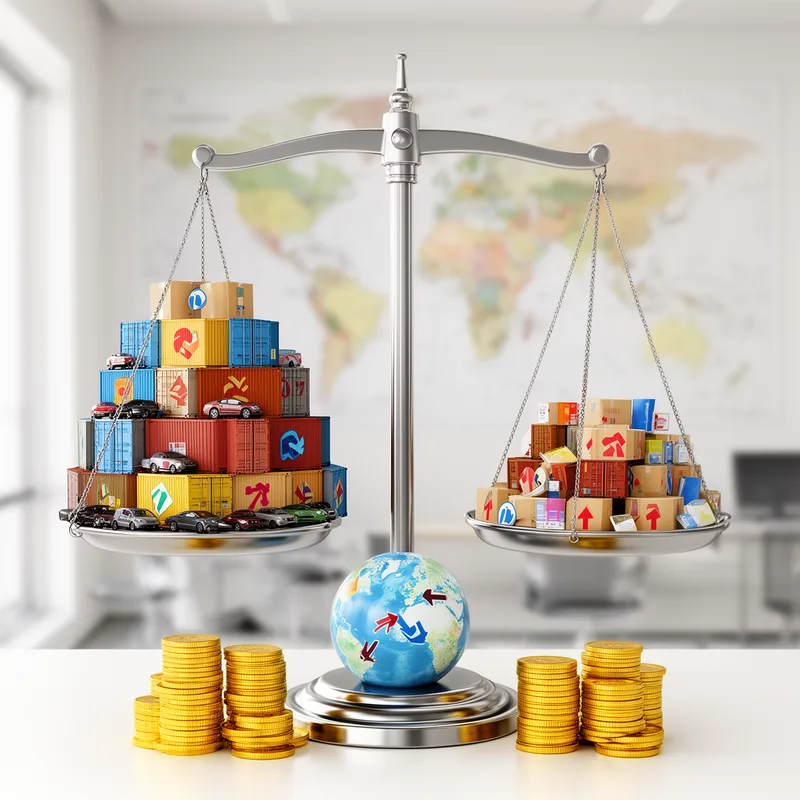
trade balance
 4
3.9
4
3.9

- noun
- /treɪd ˈbæləns/
- Specialized
- The trade balance is still favorable to the United States in agriculture and agro-industry in bilateral trade.
- improving the trade balance
Loading YouTube…
Watch on YouTubeThere is no one has ever managed to establish a serious correlation between a country's trade balance and its growth rate.
- There is no one has ever managed to establish a serious correlation between a country's trade balance and its growth rate.
Examples
-
Eventually, employment reaches satisfactory sustainable levels, and a consensus trade balance is achieved.
Blog text (24) -
Perhaps most importantly, a weaker dollar's effect on the trade balance, and thus on growth, is limited by two factors.
Blog text (25) -
Clearly, the easiest and most commonly used way is to look at the trade balance between two countries.
Academic text (1997) -
In 1989, the trade balance was in deep deficit.
Academic text (1991) -
Examination of Peru's balance of payments over the past decade shows that the trade balance has usually been a positive generator of foreign exchange.
Academic text (1991) -
European governments sought favorable trade balances by controlling larger portions of the world's resources.
Academic text (2005) -
The government is concerned about the country's trade balance, which shows a deficit in imports over exports.
-
A favorable trade balance can strengthen a nation's economy by increasing its foreign exchange reserves.
-
Analysts predict that changes in policy will significantly impact the trade balance between the two countries.
Synonyms
 2
4.4
2
4.4
The difference in value of goods a country sells and buys from other countries over time
 1
3.8
1
3.8
The difference between the value of a country's imports and exports over a time period

The difference in value between a country's exports and imports of goods over time
How Positive

Surface Forms
Morphology
The meaning is a straightforward composition of 'trade' (buying and selling) + 'balance' (the net remainder or difference), so a learner who knows both words can infer this refers to the net difference in trade values. The compound follows a common, cross‑linguistic pattern (e.g. 'balance of trade') and is a transparent nominal composition, making it accessible to a B1 learner.
Etymology
The term trade balance may come from the picture of merchants using a scale: trade, the goods a country sells and buys, sat on the two sides and the balance showed which side was heavier, so the phrase came to mean the 'difference between exports and imports'.