

balance of trade
 2
4.4
2
4.4

- noun
- /ˈbæl.əns əv treɪd/
- Specialized
- In that same year, South Korea's balance of trade stood at $14 billion.
- a favorable balance of trade
Loading YouTube…
Watch on YouTubeHow much should people really worry about the balance of trade?
- How much should people really worry about the balance of trade?
Examples
-
Others discussed (somewhat uncertainly) problems related to the balance of trade and international currency exchange rates.
Academic text (1992) -
The balance of trade is the difference between the value of a country's exports and the value of its imports.
Academic text (2018) -
Regional and local development plans need to account for the global balance of trade in resources.
Academic text (1992) -
Higher oil production would boost employment and improve the balance of trade.
Blog text (3) -
Most national governments are eager to build up a favorable balance of trade.
Academic text (1992) -
The balance of trade always favored the United States.
Academic text (1998) -
America was the world's creditor and enjoyed a highly favorable balance of trade.
Academic text (1991) -
Oil and natural gas exports to China are the source of the country's wealth and balance of trade surplus.
Blog text (20) -
Opening up exploration and drilling in areas where it is now forbidden would create hundreds of thousands of jobs, significantly increase economic growth, and do wonders for the country's balance of trade, reducing oil imports dramatically.
Academic text (2011) -
Many economists believe that a positive balance of trade can strengthen a country's economy.
Synonyms
 4
3.9
4
3.9
The difference in value between a country's exports and imports of goods
 1
3.8
1
3.8
The difference between the value of a country's imports and exports over a time period

The difference in value between a country's exports and imports of goods over time
Antonyms

How Favorable
- Specialized
11
3.5

- Specialized
2
4.4
- Specialized
38
4.7
Surface Forms
Morphology
A learner who knows 'balance' (a state of proportion) and 'trade' (buying and selling) can infer that this phrase refers to some measure or state related to trade, so the basic idea is compositional. However, the precise economic sense — the numerical difference in value between imports and exports over a period — is technical and not fully predictable from the constituents alone, so it is only partly transparent.
Etymology
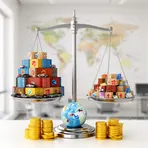
Balance of trade comes from the simple image of a pair of scales: the word balance is the scale and trade is the buying and selling between countries. Think of exports on one side and imports on the other; if exports weigh more the scale shows a 'surplus' and if imports weigh more it shows a 'deficit', so the phrase means the difference between what a country sells and buys.