
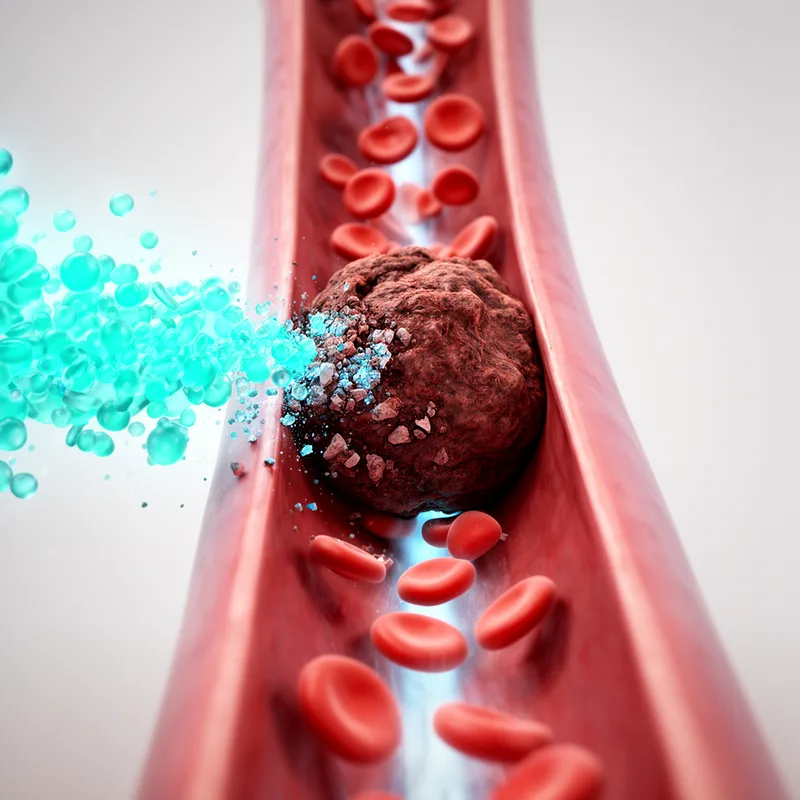
thrombolytic
- noun
- /θrɑmboʊˈlɪtɪk/
- Specialized
- The doctor recommended a thrombolytic drug to dissolve the blood clot and restore blood flow.
Examples
-
Patients experiencing a heart attack may receive a thrombolytic agent to quickly remove the blockage.
-
This advantage of very early therapy in the prehospital studies is much larger than the effect of 1 hour earlier treatment reported by the FTT investigators (1.6 lives per 1000 treated), who compared in-hospital thrombolytic with placebo or conventional therapy.
Academic text (2000) -
In emergency medicine, rapid administration of a thrombolytic is crucial for improving patient outcomes.
Synonyms

 1
3.8
1
3.8

A medicine that breaks up blood clots that block blood flow, often in the heart


 1
7.7
1
7.7
A medical treatment that breaks down blood clots in blood vessels

A drug that breaks up blood clots to restore blood flow during a heart attack or stroke
A medicine that helps break up blood clots

Use medicine to break up blood clots that cause heart attack or stroke
Compounds
- Specialized
A drug that breaks up blood clots to restore blood flow during a heart attack or stroke
- Specialized
Use medicine to break up blood clots that cause heart attack or stroke
How Strong

Surface Forms
Morphology
thrombolytic = thrombus (opaque) = thrombo + lytic
Formed from medical combining elements 'thrombo-' (clot) + '-lytic' (dissolving); these are specialized morphemes unfamiliar to average B1 learners so the meaning is not transparently derivable.
Etymology
Thrombolytic comes from the Greek parts thrombo- meaning 'clot' and -lytic from lysis meaning 'to loosen' or 'break apart', the same root you see in analysis ('breaking into parts'). So a thrombolytic is a drug that 'breaks up' blood clots to restore blood flow.