

technical foul
 7
4.3
7
4.3

- noun
- /ˈtɛknɪkəl faʊl/
- Jargon
- Technical foul, right here.
- call technical foul
- give a technical foul
- assess a technical foul
Examples
-
Technical foul on red 23.
-
Thus, female referees were especially likely to call a technical foul on female players following expressive aggressive behavior.
Academic text (2009) -
This should be a technical foul or something.
-
We got a technical foul: 23 with a push.
-
- Technical foul on red 23.
-
Guess who tends to lead the NBA in technical fouls?
Blog text (16) -
Technical foul.
-
Results indicated that both stopping the game and giving a technical foul formed the primary behavioral coping strategies.
Academic text (1996) -
Not surprisingly, however, American referees were more than twice as likely as Australians to give a technical foul for arguing.
Academic text (1996) -
The referee issued a technical foul for excessive arguing with the officials.
Synonyms
 1
6.3
1
6.3
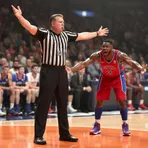
A foul given for bad behaviour not involving physical contact
How Serious
23
5.5

- Specialized
6
3.8
- Jargon
7
4.3
- Specialized
222
4.6
Surface Forms
Morphology
While 'foul' (a rule-breaking action) is transparent, the modifier 'technical' here has a specialized sports sense ('unsportsmanlike or non-contact rule violation') that a B1 learner knowing only the basic meanings may not reliably infer. Learners can guess it denotes a type of foul, but the precise conditions and consequences are sport-specific and require exposure, so the expression is partially predictable but not fully transparent.
Etymology
Technical foul comes from basketball where foul means a rule break and technical shows the problem is about rules or behavior, not physical contact. One popular story says referees used it for coaches or players who argued or behaved badly when the ball was not in play, and because it gives the other team a 'free throw', it now means a penalty for 'bad behavior'.