

to take on
 133
2.8
133
2.8

- phrasal verb
- /teɪk ɑn/
- Tennessee travels to Nashville to take on Vanderbilt in the in-state annual battle.
- take on bigger opponents
Loading YouTube…
Watch on YouTubeWho could be opposed to them to take on child sex trafficking?
- Who could be opposed to them to take on child sex trafficking?
- Today's video or the term we're going to be taking on is scapegoating.
- Because, you know, how are you going to take on this Kingdom?
- This is the first monstrosity that we will be taking on and tackling.
- Which who are you taking on from the music world?
- Showing no compromise, standing up to evil, taking on evil head on without permission.
- We'll take you on, headstrong to take on anyone.
- This is you basically taking on Nike.
Examples
-
New York ready to take on the winner of our next game, KC against Tennessee.
-
The moment where the good guys take on the bad guys.
-
Today The try guys are taking on a chess master.
-
Satisfied, he gets ready to take on the entire base if necessary.
Fiction book (1999) -
UW heads home from Vegas to take on Virginia at the Kohl Center on Wednesday.
Blog text (5) -
You're going to be watching women's surfing history today... as these girls take on the deadliest waves in the world.
-
In 1944, the Bulldogs were sporting a 7-2 record and were excited about taking on the service-talented Yellow Jackets.
Academic text (2014) -
The Cincinnati Bengals will take on the Pittsburgh Steelers in the upcoming game.
-
Tomorrow, our team will take on their biggest rival in the championship match.
-
In the final round, she will take on the reigning champion for a chance to win the title.
Synonyms
 ∞
1.0
∞
1.0
To take part in a physical or verbal struggle against someone
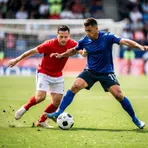 ∞
1.0
∞
1.0
Compete against another team or player in a sport
 527
2.2
527
2.2
To play against an opponent in a game or contest
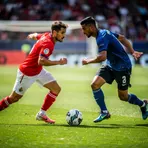 8
3.6
8
3.6
To meet an opponent in a game or match
Antonyms


How Competitive

Surface Forms
Morphology
The sense 'to compete against' is a metaphorical extension of 'take' combined with the particle 'on' and is not a simple literal composition of the two words. While a learner who knows phrasal-verb patterns might infer a confrontational or assume-responsibility sense, the specific meaning 'face/compete against' is not fully predictable without exposure, so it is only partially transparent.
Etymology
Take on comes from the idea of stepping forward to face someone in a fight or game. To take someone on is to accept the challenge of facing them, so it means 'to compete against' or 'to challenge'.