
stellar evolution


 1
7.3
1
7.3
- noun
- /ˈstɛlər ɪˈvɛluːʃən/
- Specialized
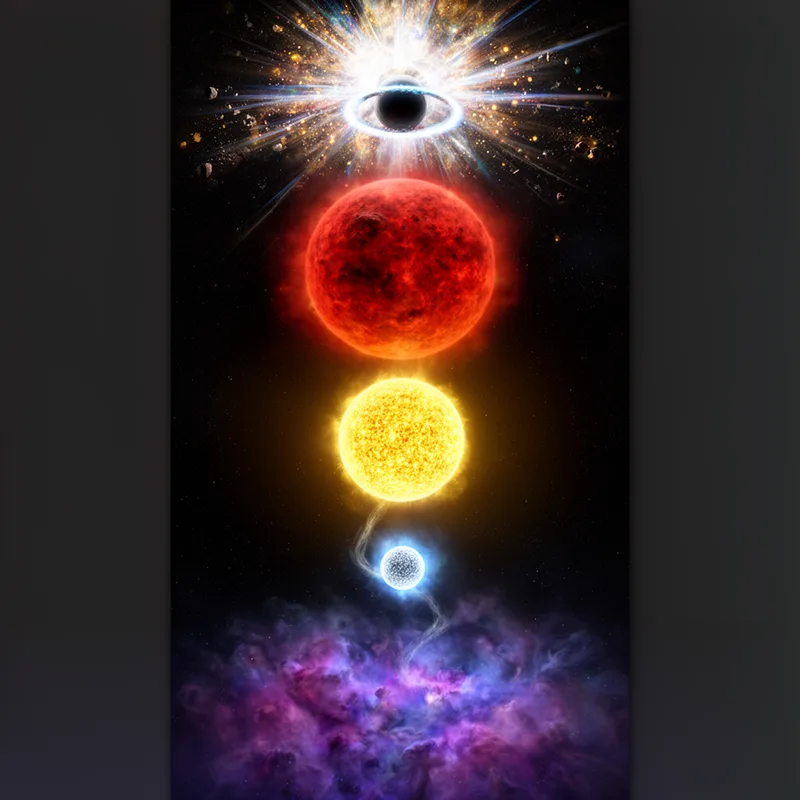
- The life cycle of a star is divided into several phases that illustrate stellar evolution from formation to explosion.
- stellar evolution theory
- stellar evolution models
Loading YouTube…
Watch on YouTubeIt was early days for these endpoints of stellar evolution.
- It was early days for these endpoints of stellar evolution.
Examples
-
Our theories of stellar structure and stellar evolution are indisputably mature.
Academic text (2000) -
In the ongoing war between gravity and thermodynamics, white dwarfs and other degenerate objects represent a stalemate of stellar evolution.
Academic text (2000) -
From then on, he used the concept to investigate star formation and stellar evolution.
Academic text (2002) -
Furthermore, the theory of stellar evolution has a number of successes to its credit.
Academic text (1990) -
Does the paradox indicate a problem with our stellar evolution models?
Academic text (2006) -
Such is the picture suggested by standard models of stellar evolution: as a star ages on the main sequence, its luminosity increases.
Academic text (2006) -
Researchers who specialize in stellar evolution have long known that the inner planets are in danger.
Blog text (6) -
Observations of solar neutrinos also constitute critical tests of the theory of stellar evolution.
Academic text (1990) -
Astronomers study stellar evolution to understand how stars are born, change, and eventually die.
-
In her research, she explained how stellar evolution varies based on a star's initial mass.
How Evolved
- Specialized
162
5.1

- Specialized
14
7.4
- Specialized
5
7.5
- Specialized
1
7.3
- Specialized
7
7.2
- Specialized
- Specialized
3
9.0
Surface Forms
Morphology
The noun phrase combines 'stellar' (relating to stars) with 'evolution' (gradual change), so a learner who knows both words can directly infer it refers to the process by which stars form and change over time. This compositional pattern (X + evolution = the change or development of X) is common and cross-linguistically transparent, making the meaning accessible to B1 learners.
Etymology
The term stellar evolution uses stellar ('star') and evolution ('gradual change') to show a star's life. So, it means the process by which a star forms, changes, and finally dies.