
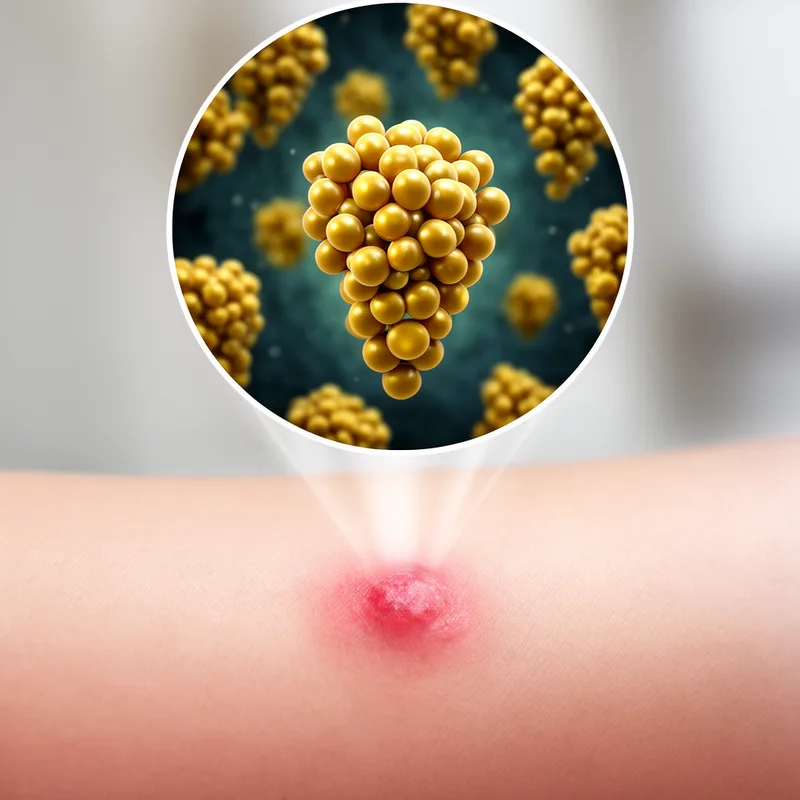
staphylococci
 1
9.5
1
9.5

- noun
- /ˌstæfɪləˈkɑːkaɪ/
- Specialized
- In the meat, the staphylococci component was largest in Abattoir D and smallest in Abattoir C.
- coagulase-negative staphylococci
- airborne staphylococci
- staphylococci counts
Examples
-
In findings similar to those of the present study, coagulase-negative staphylococci were the predominant bacteria.
Academic text (2004) -
Less frequently isolated organisms were Streptococcus viridans, Streptococcus pyogenes, Peptostreptococcus spp., and coagulase-negative staphylococci (a combined 22% of cases).
Academic text (2010) -
Coagulase-negative staphylococci were the most frequently isolated organisms in our study, as in many other studies.
Academic text (2004) -
The authors make suggestions about the role of the air environment as a vector of staphylococci contamination.
Academic text (2006) -
What is the contribution of staphylococci to the total microbial population of the meat in the deboning room?
Academic text (2006) -
Coagulase-negative staphylococci were found in 22 of the 48 patients (45.8%).
Academic text (2004) -
Our study is consistent with Hoyt's results, which demonstrated a preponderance of coagulase-negative staphylococci.
Academic text (2004) -
Culture grew 2+ coagulase-negative staphylococci and 1+ multidrug-resistant Klebsiella pneumoniae.
Academic text (2006) -
Overall, S. aureus was seen in 43.5% of cases, P. aeruginosa in 28.8%, coagulase-negative staphylococci in 7.3%, and Enterobacter species in 3.4%.
Academic text (2005) -
Infected wounds commonly show the presence of staphylococci, leading to complications.
Synonyms
 14
7.6
14
7.6
A type of bacteria that can cause skin or blood infections and can be hard to treat with antibiotics
 3
7.9
3
7.9
A kind of bacteria that lives on skin and can cause infections like boils

A group of round bacteria, many of which cause skin infections, pneumonia and food poisoning
Surface Forms
Morphology
staphylococci = staphylococcus (opaque) = staphylo + coccus + i
The plural is formed with a Latin scientific plural '-i' and the components are specialised Greek/Latin combining forms unfamiliar to average learners, so the meaning is not predictable from common English vocabulary.
Etymology
Staphylococci comes from Greek parts staphylo- meaning 'bunch of grapes' and -cocci meaning 'round cells', like 'berries'. That's why these bacteria look like grape-like clusters of round cells under a microscope and why some can cause skin or blood infections.