
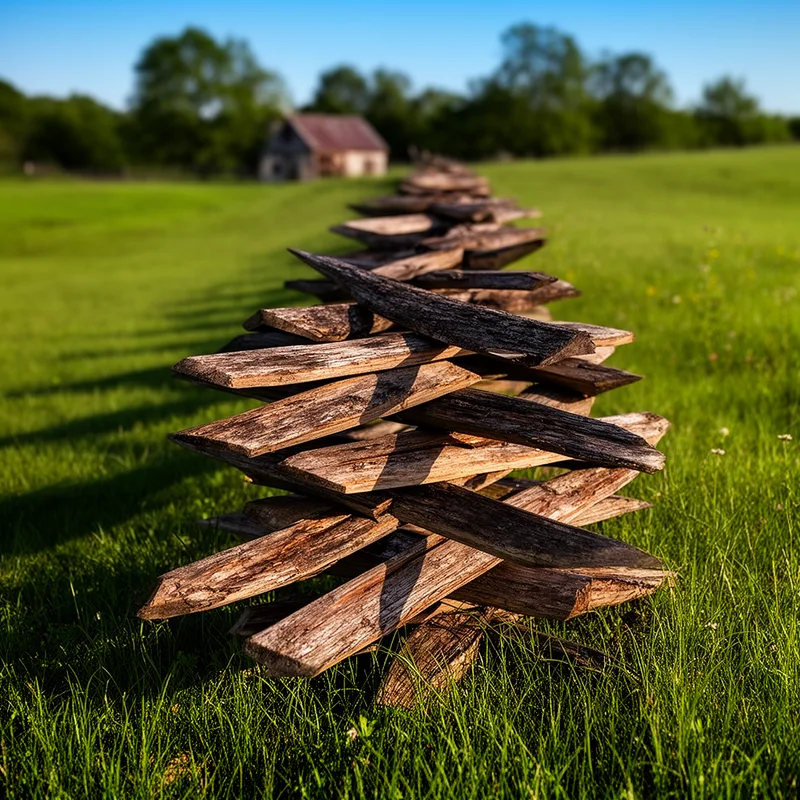
split-rail fence


 1
4.8
1
4.8
- noun
- US
- The picturesque split-rail fence zigzagged across the farm, showcasing the traditional construction of stacked logs.
Examples
-
Now, even the front split-rail fence bordering High Point Farm was falling down in sections.
Fiction book (1997) -
They sniffed at the Dalmatian, and then instantly the dogs were fighting, two against one, and we were climbing to stand on the split-rail fence; the younger ones backed up against an adjacent oak for balance.
Fiction book (2001) -
Like a split rail fence.
-
And we added a split rail fence.
Blog text (20) -
Split rail fence, a pond, a stretch of woods.
-
Then slipped through the split-rail fence into the adjacent yards.
Fiction book (2001) -
At the far end is an old gray split-rail fence, and beyond it, a small hill dotted with headstones.
Fiction book (1995) -
He let his eyes scan the split-rail fence that bordered the cornfield.
Fiction book (1990) -
The end of the alleyway was in sight; the graveyard next to the Presbyterian church was just ahead, set apart from the scourge of commerce by a split-rail fence.
Fiction book (1998) -
The only sounds were the long-drawn late summer rattle of locusts and the chirp of crickets from the meadow beyond the split-rail fence that divided it from the lawn.
Fiction book (1990)
Synonyms
 1
4.3
1
4.3
A fence made of long wooden rails laid in a zigzag to keep animals in

A low wooden fence made of rails in a zigzag that marks a border

A low wooden rail barrier that forms a zigzag pattern to mark or enclose land

A fence made of wooden rails laid in a zigzag pattern
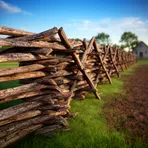
A wooden fence made of rails laid in a zigzag pattern without posts
How Sturdy

Surface Forms
Morphology
split-rail + fence
The noun is compositionally built from 'split' (divided) + 'rail' (a long bar or wooden rail) combined with 'fence', so the phrase denotes a fence made from split rails. This follows normal English compounding patterns, so a B1 learner who knows the constituent words can reliably infer the meaning.
Etymology
Split-rail fence comes from how the fence was made: people would split logs into rails and stack them horizontally, often in a zigzag, to make a simple 'fence'. That's why the name shows the wood is split and the structure marks a 'boundary'.