

worm fence
- noun
- /wɜrm fɛns/
- Archaic
- A worm fence requires no nails and is often seen in traditional American landscapes.
Examples
-
The worm fence surrounded the old farmhouse.
-
They spent the afternoon repairing the damaged section of the worm fence along the property line.
-
The old farmhouse was surrounded by a worm fence that gave it a rustic charm.
-
They built a new worm fence in the backyard.
-
In the countryside, many farms still feature a worm fence to outline their fields.
-
The old worm fence added charm to the rustic landscape of the farm.
-
As we walked along the path, we admired the traditional worm fence that zigzagged through the pasture.
Synonyms

 1
4.3
1
4.3

A fence made of long wooden rails laid in a zigzag to keep animals in


 1
4.8
1
4.8
A fence made from split logs stacked horizontally in a zigzag

A low wooden fence made of rails in a zigzag that marks a border

A low wooden rail barrier that forms a zigzag pattern to mark or enclose land
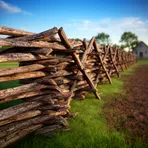
A wooden fence made of rails laid in a zigzag pattern without posts
Surface Forms
Morphology
Although 'fence' is transparent, the element 'worm' for most learners evokes the invertebrate and does not transparently signal a zigzag rail construction. This is a regional/historical lexicalized name whose specific sense (zigzag rails) cannot be predicted from the constituent meanings, so a B1 learner who only knows 'worm' and 'fence' would likely not infer the intended meaning.
Etymology
Worm fence gets its name from the fence's long zigzag shape that looks like a wriggling worm, because the wooden rails are stacked in a back-and-forth line without nails. That's why worm fence means a low, zigzag wooden fence.