

skeleton key


 1
6.7
1
6.7
- noun
- /ˈskɛlɪtən ki/
- She used the skeleton key to unlock all the doors in the old mansion.
Examples
-
I fumbled again with the awkward skeleton key.
Fiction book (1995) -
I jammed the skeleton key into the lock and turned it.
Fiction book (1995) -
Harley took his grandmother's hand and gave her the rusty skeleton key he'd found in the yard.
Fiction book (1992) -
From the shelf, he retrieved one of those old bowstemmed long iron "skeleton" keys that would pass the wards and trip the simple bolt of any lock in town.
Fiction book (1998) -
Clumsily, I unlocked the outer door with an oversized skeleton key and switched on the light in the vestibule.
Fiction book (1995) -
Gladstone stopped at one of the doors, removed a skeleton key from his pocket, and unlocked the bolt, swinging it open on its hinges to reveal a room containing half a dozen steel tables.
Fiction book (1998) -
The antique dealer showed us a skeleton key that could open many different locks.
-
He carefully inserted the skeleton key and turned it to unlock the hidden compartment.
Synonyms
 4
3.4
4
3.4
A key that opens many different locks in a building
 2
6.0
2
6.0
A key that opens every lock in a set, like all rooms in a building
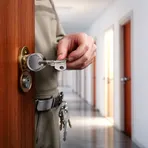
A key that opens many locks in a building
How Universal
1
6.7
 ∞
1.0
∞
1.0
Surface Forms
Morphology
The compound contains the transparent element 'key' (an opener) but 'skeleton' does not directly signal 'master' or 'universal'—learners might guess a special or unusual key but would not reliably infer the precise meaning 'a credential/backdoor that bypasses authentication'. The extended computing sense (password/backdoor) is a metaphorical extension of a physical master key and is therefore partially predictable but requires prior exposure, so this is best classified as semi-transparent.
Etymology
Skeleton key comes from the image of a bare, 'skeleton' key: key makers filed down most of the teeth so one key could open many different locks. So, it means 'a key that opens several locks'.