

passe-partout
- noun
- /ˌpæs.pɑːrˈtuː/
- The caretaker carried a passe-partout that unlocked every office in the building.
Examples
-
After losing the original, the hotel manager used the passe-partout to enter the guests' rooms.
-
Only trusted employees are given access to the passe-partout for security reasons.
-
The manager gave me a passe-partout for the entire building.
-
Can you find a passe-partout for this hotel?
-
The maintenance worker always kept a passe-partout handy to quickly access various rooms in the building.
-
For convenience, the hotel provides staff members with a passe-partout to open any guest room door.
-
He checked that the passe-partout worked on every lock before starting his rounds in the office complex.
Synonyms

 37
6.1
37
6.1

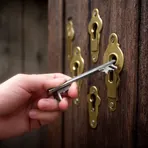
A key that opens many different locks in a building
 4
3.4
4
3.4
A key that opens many different locks in a building
 2
6.0
2
6.0
A key that opens every lock in a set, like all rooms in a building

 1
6.7
1
6.7
A metal tool that opens many similar locks by having most teeth cut away
How Universal

Surface Forms
Etymology
Passe-partout comes from the French words passer and partout, meaning 'to pass' and 'everywhere'. That's why a passe-partout can mean a master key — a key that can 'pass' through many locks and open lots of doors.