

sclerosis
 27
8.3
27
8.3

- noun
- /skləˈroʊsɪs/
- Specialized
- So multiple sclerosis is an autoimmune disease that in which your body attacks your nervous system.
- multiple sclerosis
- amyotrophic lateral sclerosis
- lateral sclerosis
Loading YouTube…
Watch on YouTubeThere's a case study that just came out on ALS, amyotropic lateral sclerosis or Lou Gehrig's disease.
- There's a case study that just came out on ALS, amyotropic lateral sclerosis or Lou Gehrig's disease.
- It turns out the incidence of depression as a comorbidity in multiple sclerosis is enormous.
- My mom has a disease called multiple sclerosis and one of the side effects is depression.
- Now since then there's been a lot of research to show how stress and trauma potentiate multiple sclerosis.
- I have multiple sclerosis, or I have rheumatoid arthritis, or I have ADHD or I have depression or I have addiction.
- They'll induce a, a multiple sclerosis like syndrome in mice and show that by changing gut microbes you can change the rate at which these diseases progress.
- I think he had that hypodermosis, scholars, sclerosis.
- And the question is, and it also may happen in ALS, sometimes referred to as Lou Gehrig's disease and mitrophic lateral sclerosis.
- Like I'm on one drug for the multiple sclerosis, for spasticity.
- Unfortunately, things like brain tumors and conditions like multiple sclerosis will catch those.
- And then they had these white matter disease in their head in their brain looks like multiple sclerosis.
- My wife getting diagnosed with multiple sclerosis like yo, it's just life y'all life ain't life.
- Grief grief A Danish study parents who lost a child have doubled the risk of multiple sclerosis.
- And so we had some of the first clinical trials of cannabis for pain and for spasticity and multiple sclerosis.
Examples
-
Clinical patterns of multiple sclerosis have been defined by international consensus.
Academic text (2002) -
Um, seven months after we were married, we found out that I had multiple sclerosis.
-
My mom has a disease called multiple sclerosis and one of the side effects is depression.
-
Later, she told me that when she was six, her father developed multiple sclerosis and needed a wheelchair.
Fiction book (1991) -
My wife has multiple sclerosis and can't even walk half the time without a cane.
-
Mrs. X suffers from end-stage multiple sclerosis and can no longer move either leg or her left arm.
Academic text (2008) -
It turns out the incidence of depression as a comorbidity in multiple sclerosis is enormous.
-
I have multiple sclerosis, or I have rheumatoid arthritis, or I have ADHD or I have depression or I have addiction.
-
The practice nurse is likely to see patients with Parkinson's disease, multiple sclerosis, epilepsy, motor neurone disease, and dementia.
Academic text (2011) -
Many people with sclerosis experience varying degrees of mobility loss over time.
Synonyms
 3
7.5
3
7.5
A medical problem when body tissue becomes thick and less flexible

A hard area under the skin that forms after infection or injury
Compounds

- Specialized
21
5.1
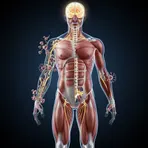
A long-term disease that damages the covering of nerves in the brain and spinal cord, causing weakness and vision problems
- Specialized
1
6.8
A disease that slowly destroys nerve cells in the brain and spinal cord that control muscles

- Specialized
1
5.6
Hardening and thickening of artery walls that reduces blood flow from the heart

- Specialized
A long-term disease of the nerves that causes patches of damage to their protective covering often causing numbness and weakness

- Archaic
A long-term disease that damages nerves in the brain and spinal cord
How Hard
- Specialized
1
8.8

- Specialized
3
7.1
- Specialized
27
8.3
- Specialized
4
4.6
Surface Forms
Morphology
sclerosis = scler + osis
Although analyzable into the combining form 'scler-' (hard) + '-osis' (condition), these Greek combining forms are not productive or familiar to an average B1 learner, so the meaning 'hardening' is not reliably derivable.
Etymology
The word sclerosis comes from the Greek root skleros, which means 'hard'. It describes when body tissue becomes hard or thick, so that's why sclerosis means a 'hardening' of tissue.