
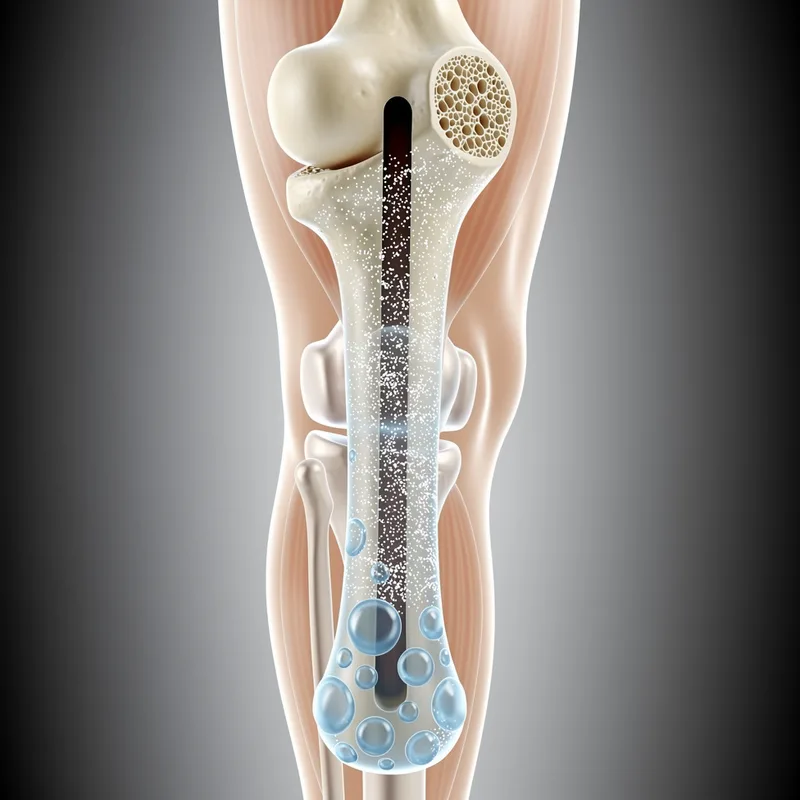
ossification
 1
8.8
1
8.8

- noun
- /ˌɑsɪfɪˈkeɪʃən/
- Specialized
- All other bones in the body, however, develop by endochondral ossification.
- secondary ossification
- ossification centers
- process of ossification
Examples
-
Ossification of such metastases from esophageal cancer is a rare event.
Academic text (2007) -
Skeletal development occurs through a process known as osteogenesis or ossification.
Academic text (2006) -
There are four phases of healing that depend on the degree of ossification of the callus about the fracture site.
Academic text (2003) -
Throughout childhood, secondary centers of ossification form and enlarge until the entire cartilage skeleton has been replaced by bone.
Academic text (2006) -
The fusion of three ossification centers, the ilium, the ischium, and the pubis, makes up the innominate bone.
Academic text (2006) -
The majority of the skull bones and the clavicle develop through intramembranous ossification, in which the bones are formed directly from an embryonic tissue known as mesenchyme.
Academic text (2006) -
Hips with mild or moderate dysplasia, suspected avascular necrosis, or absent or delayed ossification of the capital femoral epiphysis were judged to have borderline abnormalities.
Academic text (2002) -
The process of ossification begins with the formation of cartilage, which later hardens into bone.
-
In humans, ossification is essential for skeletal growth and the transition from soft tissue to rigid bone.
-
During ossification, the body transforms cartilage into bone, gradually providing support as a child grows.
Synonyms
 3
7.4
3
7.4
New bone forms in the body
Antonyms


How Hard
- Specialized
1
8.8

- Specialized
3
7.1
- Specialized
27
8.3
- Specialized
4
4.6
Surface Forms
Morphology
Etymology
Ossification comes from the Latin root oss- meaning 'bone' and the part -fication meaning 'making'. So it literally means 'making into bone', which is why we use it for the process that turns soft tissue into hard bone.