

to scare off
 68
2.7
68
2.7

- phrasal verb
- /skɛr ɔf/
- The looks from the small group of family members sufficed to scare off the man on the bike.
- scare off investors
Loading YouTube…
Watch on YouTubeBut yes, understand that your accomplishments can scare off certain men.
- But yes, understand that your accomplishments can scare off certain men.
- You want to scare off the wrong guys faster to attract the right guy faster.
- They, they, they wanted me gone and they felt that arresting me would, would scare me off.
- And now the last thing that will scare off good men or scare good men off is not showing enough interest.
- And we we were both just there on the landing because we don't want to scare them off just listening to and there we go.
- And the cops were told to go out and confiscate all of this stuff and arrest some of the news dealers just to scare them off.
Examples
-
I use the eye and the music to scare them off.
Fiction book (1996) -
Did I scare him off?
-
Maybe you scared them off.
-
We're really gonna scare them off.
-
Why was he trying to scare me off the case?
-
Trying to scare off the girls with those nails?
-
We don't wanna scare her off.
-
We don't want to scare potential buyers off with all the noise.
-
"If you're trying to scare her off, you'll have to do better than that."
Fiction book (1998) -
The loud noises from the construction site scared off the birds that usually gather in the park.
Synonyms
 294
4.9
294
4.9
To frighten someone so they do what you want
 71
3.4
71
3.4
To force a person, animal, or feeling to go away
 47
2.5
47
2.5
Make a person or animal go away because they are afraid
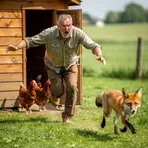 6
3.3
6
3.3
Make someone or something leave a place by running after and frightening them
 5
4.1
5
4.1
To make people or animals go away by waving your hand
 1
3.3
1
3.3
To make someone or something go away by making them afraid
 1
8.1
1
8.1
Make animals or people who attack you go away
 1
2.8
1
2.8
To make people or animals go away by scaring them
 1
5.4
1
5.4
Make a person or animal go away with words and gestures
Antonyms


How Scary
68
2.7
 94
5.6
94
5.6
Surface Forms
Morphology
The meaning 'to make someone or something go away by frightening them' is directly and transparently built from 'scare' (to cause fear) plus the particle 'off' (away), with 'off' indicating movement or removal. This verb + particle compositional pattern is regular in English and cross-linguistically common, so a B1 learner who knows the parts can infer the MWE meaning.
Etymology
Scare off: The phrasal verb scare off comes from the simple image of scare meaning 'to frighten' and off meaning 'away', like a loud noise that frightens birds so they fly away. That's why scare off means 'to make someone or something go away or stop doing something by frightening them'.