

quadrant
 10
7.5
10
7.5

- noun
- /ˈkwɒdrənt/
- Specialized
- I don't suppose you happened to note down its quadrant in the sky?
- quadrant, astrolabe
Examples
-
The Portuguese had the three-mast ship, the compass, the quadrant, the astrolabe, navigation charts, and a comparatively good knowledge of winds, currents, stars, and latitudes.
Academic text (1995) -
Without a map, compass or quadrant, there's no way to be certain.
-
Holding a quadrant, he is aiming at the stars.
Fiction book (1992) -
In 1769, he used Harvard's eight-foot reflecting telescope and pendulum clock and borrowed the astronomical quadrant belonging to Joseph Harrison.
Academic text (2004) -
When the Portuguese reached the Guinea Coast, they did so in three-masted oceangoing sailing ships using a compass, quadrant, astrolabe, navigation tables and charts, and knowledge of stars, winds, currents, and latitudes.
Academic text (1992) -
Using a quadrant, sailors can measure the angle of the stars to navigate accurately.
-
During the astronomy lesson, each student used a quadrant to measure the height of the sun.
-
He carefully adjusted the quadrant to get a precise reading of the highest point in the sky.
Synonyms
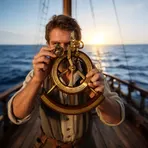
An old instrument sailors used to measure angles to the sun or stars up to 45 degrees
How Advanced
- Specialized

 1
9.9
1
9.9

- Specialized
4
9.5
- Archaic
2
9.9
- Specialized
10
7.5
- Archaic
Surface Forms
Morphology
quadrant = quarter (semi-transparent) = quadr + ant
The instrument is named for its quarter-circle shape (relating to 'fourth'), but the name comes through a Latin formation rather than a transparent modern English derivation.
Etymology
The word quadrant for the measuring tool also comes from that idea of 'a quarter' of a circle, and you can see the same root in quarter and quadruple. The instrument is shaped like a quarter circle, so it was called a quadrant and used to measure the height of stars and other angles.